

Best Property Managers With Dynamic Pricing 2026
Seven full-service vendors, the fee ranges that actually hold up under scrutiny, and the operator profile each one fits.

In this essay · 13 sections
- 01 TL;DR: Best Full-Service Property Managers With Dynamic Pricing at a Glance
- 02 A Story Most Owners Don’t Hear Until Year Two
- 03 What “Full-Service Property Management” Actually Means in Short-Term Rentals
- 04 The Three Models of STR Revenue Management
- 05 When a Full-Service Property Manager Is the Right Answer
- 06 How to Evaluate a Property Manager That Offers Dynamic Pricing
- 07 The Decision Framework: Which Full-Service PM Fits Your Portfolio?
- 08 The Vendors
- 09 What’s Not a Property Manager (and Why It Matters)
- 10 Common Mistakes Operators Make When Choosing a Full-Service Property Manager
- 11 When to Choose RevFactor (Model 2) Instead
- 12 Coverage Map: Which Full-Service Property Managers Operate Where
- 13 The Bottom Line: Pick the Model Before You Pick the Manager
QUICK ANSWER
The best full-service Airbnb property managers with dynamic pricing in 2026 split across three operator profiles. National scale and deepest infrastructure: Vacasa. Portfolio operators in vacation markets with 10+ units: AvantStay. Lower-fee co-host hybrid for hands-on owners: Evolve. Investor-focused with transparent reporting: Awning. Regional franchise with local intelligence: iTrip. Urban-and-leisure boutique: Roami. Every vendor in this list bundles pricing into the operational fee, which is meaningfully different from hiring a dedicated managed revenue management service that handles pricing only.
Key Takeaways
- Full-service property management is one of three distinct models for STR revenue management — the right answer for owners who want a true operational handoff, not for hands-on operators who only want their pricing discipline professionalized.
- Fees in this category range from roughly 10% of bookings (Evolve’s co-host model) to 35% of gross revenue (Vacasa’s premium-service tier), and the headline number says less about value than the methodology behind it.
- Pricing methodology transparency is the single most undervalued evaluation criterion. Most full-service PMs run pricing inside a black box that the owner does not see and cannot audit.
- Owner-facing revenue reporting cadence and detail vary wildly. Some managers deliver weekly pacing reads; others deliver monthly statements with no underlying pricing logic. Ask for sample reports before signing.
- Portfolio minimums matter. AvantStay generally requires 10+ units. Awning concentrates in select metros. Vacasa and Evolve take single properties. Make sure you fit the vendor’s actual operating profile before falling for the pitch.
- The most expensive mistake in full-service PM selection is paying for convenience and discovering, two years in, that the pricing layer was the part you most needed to keep close to. This is where managed RM as a separate vendor often produces better economics.
- Hostfully is a property management system (PMS software), not a full-service management company. Rented (now TravelNet) is a managed revenue management service, not a full-service PM. Knowing what is and isn’t in this category saves wasted discovery calls.
TL;DR: Best Full-Service Property Managers With Dynamic Pricing at a Glance
| Company | Best For | Typical Fee | Pricing Approach | Geographic Coverage |
|---|---|---|---|---|
| Awning | STR investors wanting investor-grade reporting | Approximately 15-25% of gross revenue | In-house pricing methodology, transparent revenue accounting | West Coast and select metros |
| AvantStay | Portfolio operators with 10+ premium units in vacation markets | Approximately 25-30% of gross revenue | In-house pricing technology, design-led positioning | Concentrated in vacation markets |
| Vacasa | Owners wanting the largest national platform and deepest operational scale | 25-35% of gross revenue | In-house revenue team, proprietary tooling | National (US) |
| Evolve | Hands-on owners wanting a lower-fee co-host hybrid | Approximately 10% of bookings | Centralized dynamic pricing as part of subscription | Broad US coverage |
| iTrip | Owners in iTrip franchise markets wanting local-knowledge pricing | Variable by franchise | National tech stack with local-market application | Franchise-dependent |
| Roami | Owners in select urban and leisure markets wanting boutique full-service | On request | Boutique pricing methodology | Select urban and leisure markets |
A note on “On request” and ranges. Most full-service PMs do not publish a single fee number because the actual contract depends on property type, market, services included, length of agreement, and portfolio size. Treat every number above as a starting frame, not a quote. The discovery call is the only path to a real number.
A Story Most Owners Don’t Hear Until Year Two
A few months ago, an owner in a Smoky Mountains market reached out after eighteen months with one of the largest full-service property managers in the country. He had three cabins. His annual revenue across the portfolio was up 6% year over year, which sounded fine until he walked through the actual line items.
The market had grown 14% over the same window. His comp set had grown 11%. His own portfolio, sitting under the same brand of full-service management he had hired specifically because the brand promised expertise, had grown less than half what comparable inventory had grown. The fee structure ate roughly 28% of gross revenue. The owner-facing revenue reporting was a monthly statement of bookings, payouts, and a high-level summary of “pacing strong.” There was no underlying pricing logic he could see, no rate-card view, no comp-set discussion, no pacing reads he could interrogate.
He wasn’t being mismanaged in any visible, contractable way. He was being averaged. His properties were three lines in a portfolio of forty thousand. The pricing was set by an algorithm with rules written for an entire region, applied uniformly. When demand softened for his particular type of cabin at his particular elevation, no one was watching closely enough to notice. The market grew. He didn’t. The fee came out of the top of every booking, regardless.
This is the experience I hear most often from owners who started with full-service management and migrated to something else. It’s not a horror story about a single vendor. It’s a structural reality of the model. When pricing is one of thirty operational responsibilities bundled into a single fee, the strategic discipline of pricing tends to get averaged across the portfolio rather than tuned for the specific property. That averaging works fine for operators who genuinely want to be hands-off. It works less well for operators who want their pricing professionally managed but had assumed “full-service” meant “specifically excellent at every layer.”
This article exists to help the second group of operators figure out where they actually fit, before they sign a contract that takes 25% of their gross revenue for the next two years.
What “Full-Service Property Management” Actually Means in Short-Term Rentals
Full-service property management in the short-term rental category means a single vendor takes operational ownership of a property and runs it on the owner’s behalf. The owner retains title to the property, sets the broad strategy (which markets to operate in, what to invest in, when to refurbish), and reviews monthly statements. The manager handles everything else.
The typical operational scope includes guest communication across booking, stay, and post-stay; cleaning and turnover coordination; maintenance triage and vendor management; listing creation and ongoing optimization across Airbnb, Vrbo, Booking.com, and direct channels where relevant; pricing strategy and rate execution; owner reporting; and tax-related documentation in many markets. The exact scope varies vendor to vendor and is worth confirming line by line in a discovery call rather than assumed from a marketing page.
What separates the full-service category from adjacent options is the consolidation. The owner has one vendor relationship, one fee structure, and one point of accountability. The fee structure compensates the manager for the entire operational stack, including pricing, which is why headline percentages run higher than what an operator would pay if pricing alone were broken out and handled by a managed revenue management service.
That single decision, bundling pricing into the operational fee, is the most consequential and least-discussed structural choice in the category. It’s what makes full-service management convenient. It’s also what tends to obscure the pricing methodology, dilute the pricing specialization, and produce the kind of “averaged out” experience the Smoky Mountains owner described. The mechanics underneath that averaging are easier to see when you have a working command of ADR vs RevPAR, which is the metric layer most full-service statements obscure.

“In a full-service engagement, the pricing methodology is the part of the relationship the owner sees least clearly and pays for most consistently.”
— Federico Zimerman
The Three Models of STR Revenue Management
This article is the deep dive into Model 3 of a framework the best STR revenue management companies of 2026 listicle laid out in full. The short version is that the entire revenue management market sorts into three models, and getting the model right matters more than getting the vendor right.
The Strategic Frame
three models of STR revenue management
Sort the market once. Pick the model that fits your operating profile. Then evaluate vendors inside that model.
01
Model 1 — Software
you drive the tool.
PriceLabs, Beyond, Wheelhouse. The tool moves the rate. You make the calls.
operator-led pricing.
02
Model 2 — Managed RM
specialist runs the pricing layer.
RevFactor, Pacer, RevPARTY. You keep operations. They run the calendar.
pricing without the handoff.
03
Model 3 — Full-Service PM
one vendor runs everything.
Vacasa, AvantStay, Evolve, Awning. Pricing is one of thirty bundled responsibilities.
convenience, with a fee.
The Model 1 deep dive on tools and how to operate them lives in our dynamic pricing guide for STR beginners. The Model 2 deep dive on specialist managed revenue management services lives in the listicle linked above. The Model 3 deep dive, full-service property managers that bundle dynamic pricing into operational management, is the work of this article.
The foundational discipline underneath all three models is documented in our pillar on revenue management for short-term rentals, which is worth reading before any vendor conversation.
When a Full-Service Property Manager Is the Right Answer
The decision to hire a full-service property manager is not, principally, a pricing decision. It’s an operational decision. The questions that actually sort owners into Model 3 territory are about time, willingness to be on call, comfort with vendor management, and tolerance for revenue averaging.
You are a strong candidate for full-service property management if all or most of the following are true.
You own one to three properties and the operational load of running them yourself feels like a second job you do not want. You travel frequently, live far from the property, or otherwise can’t realistically be reachable for guest issues. You have no experience contracting cleaners, building turnover routines, handling maintenance vendors, or managing OTA listings, and no interest in developing those skills. You value the consolidation of having one vendor accountable for outcomes more than you value visibility into the specific operational decisions being made. The 15-35% fee, in your math, is genuinely worth not having to think about the property month to month.
You are a poor candidate for full-service property management if all or most of the following are true.
You already operate the property well. Your cleaners are reliable, your guest communications are tight, your listings are converting, your operational rhythm works. Your gap is specifically pricing — you suspect, based on month-over-month performance or a comp-set comparison, that you’re leaving 10-20% of revenue on the table because no one is actively managing the calendar with strategic discipline. You want visibility into the pricing decisions being made on your property. You’re comfortable being involved in operational decisions and don’t want to delegate them.
The first group should read the rest of this article and pick a vendor. The second group should read our best STR revenue management companies of 2026 listicle and consider Model 2 instead. Both are legitimate answers. The mistake is conflating them.
How to Evaluate a Property Manager That Offers Dynamic Pricing
The evaluation framework below applies to every full-service property manager in this category. Use it in discovery calls. Use it to compare vendors apples-to-apples. Use it to identify red flags before you sign.
1. Fee Structure
There are three fee models in this category: percentage of gross booking revenue (the most common), flat monthly per property (rare), and hybrid arrangements that combine a base fee with performance components (also rare).
Percentage-of-revenue fees in this category typically run 15-35%. Anything quoted below 12% is either an unusually competitive market, a co-host hybrid like Evolve where the owner does more of the operational work, or a model where the headline rate is supplemented by additional fees that aren’t immediately visible. Anything above 35% is unusual for a standard residential STR engagement and should be interrogated.
What matters more than the headline percentage is what’s included at that price. Ask for an explicit, written list of services covered by the fee, services available at additional cost, and pass-through costs the owner is responsible for. Cleaning fees are sometimes pass-through to the guest, sometimes absorbed by the manager, sometimes a markup line item that goes to the manager directly. Maintenance is sometimes coordinated at no additional charge, sometimes billed by the hour, sometimes both depending on scope. The headline fee is one number on a much longer page.
2. Pricing Methodology Transparency
This is the criterion most owners never ask about and most regret not asking about. In a full-service engagement, the manager controls the rate. The owner sees the bookings that result from the rate. The owner typically does not see the methodology, the floors, the ceilings, the comp set the manager is pricing against, the algorithm rules, or the rationale for any individual pricing decision.
Ask, in the discovery call, the following questions and rate the answer by specificity rather than confidence.
What tool or platform handles the dynamic pricing? Is it proprietary, or are you a customer of PriceLabs, Beyond Pricing, or Wheelhouse, with a layer on top? Who reviews the pricing outputs? Is it a dedicated revenue manager assigned to my property, or a regional team that covers many properties, or an algorithm with no regular human review? What cadence does the human review happen on? Daily, weekly, monthly, only when triggered by performance alerts? How is the comp set for my property defined and how often is it refreshed? What floors and ceilings are set on my rate, and how are those numbers chosen? When the algorithm and human judgment disagree, who wins, and how is that decision logged?
Vendors who answer specifically are more likely to be running disciplined pricing. Vendors who answer in generalities (“our proprietary AI optimizes pricing in real time using market signals”) are more likely to be running pricing through a black box the owner will never see into. That doesn’t necessarily mean they’re running it badly. It does mean the owner has no way to audit, no way to push back, and no way to know whether their property is getting averaged across the portfolio.
3. Owner-Facing Reporting Cadence and Detail
A monthly statement of bookings and payouts is the floor. It is not enough.
Strong full-service managers provide weekly or biweekly pacing reads against prior year and comparable periods, a comp-set summary that names the comp set, a pricing-decision log or rate-card view, an occupancy-versus-rate breakdown, and an owner-friendly summary of strategic decisions made in the period. Weaker managers provide a monthly transaction statement and a phone number to call if you have questions.
The depth of reporting is a leading indicator of the pricing discipline behind it. Vendors who run tight pricing tend to want owners to see the work. Vendors who run sloppy pricing tend to want owners to see only the topline.
4. Markets and Portfolio Specialization
Some full-service managers specialize geographically. AvantStay concentrates in vacation markets. Awning is strongest on the West Coast and in select metros. iTrip’s quality varies by franchise location. Roami targets specific urban and leisure markets. Vacasa is national.
Some specialize by property type. Some take only premium inventory above a minimum rate threshold. Some focus on cabins, others on beach houses, others on urban units.
Some have portfolio minimums. AvantStay generally requires 10+ units. Some won’t take single-property owners at all. Others will, but provide a lower service tier because the unit economics don’t support the same attention.
The right question is not “is this manager good,” but “is this manager good at properties like mine, in markets like mine, at portfolio sizes like mine.”
5. Tech Stack Disclosure
Full-service managers run on a stack of tools — a property management system (PMS), a channel manager, a pricing tool, a guest messaging platform, a cleaning coordination system, and accounting infrastructure. Some build proprietary stacks. Most buy software from category leaders (Streamline, Track, Guesty, Hostaway, PriceLabs, Breezeway, Operto) and layer their own processes on top.
Owners do not need to know every tool. Owners do need to know whether the stack is mature enough to provide consistent service quality, whether the manager is investing in tooling or letting it deteriorate, and whether the data being captured in the stack is available to the owner in any form. If the manager can’t explain their stack at all, that’s a red flag. If they can, the specifics matter less than the disclosure itself.
6. Owner Control Retained Versus Surrendered
The most uncomfortable question in this category, and the one most worth asking, is what decisions the owner gets to make and what decisions are taken away.
Can the owner set a minimum rate floor and require the manager to honor it? Can the owner block dates personally without penalty? Can the owner request a specific cleaning company they already trust? Can the owner approve major maintenance spend above a threshold? Can the owner request a change in pricing strategy and have it implemented, or is the manager’s pricing call final?
These answers vary enormously. Some managers are highly accommodating. Some are essentially non-negotiable on operational matters because their operating model depends on standardization. Both are legitimate business models. Neither is automatically wrong. The owner just needs to know which one they’re signing with.

“The full-service contract is where convenience gets bought. Read every line.”
— Federico Zimerman
The Decision Framework: Which Full-Service PM Fits Your Portfolio?
Use the table below as a starting filter. It’s not a substitute for the discovery call. It is a way to rule vendors out before you spend an hour on a sales call.
| If your situation is… | Likely fit | Why |
|---|---|---|
| 1-3 properties, any market, want a true hands-off relationship | Vacasa or iTrip (if in a strong local franchise) | National scale or regional depth; mature operational machinery |
| 10+ premium units in vacation markets | AvantStay | Portfolio focus, design-led, vacation-market specialization |
| Hands-on owner, willing to do some operational work, wants a lower fee | Evolve | Co-host hybrid; pricing included; lower fee in exchange for owner involvement |
| STR investor who wants transparent reporting and clean revenue accounting | Awning | Investor-grade reporting positioning, transparent revenue methodology |
| Owner in a regulated urban market or distinctive leisure market | Roami or strong local iTrip franchise | Local specialization is a real differentiator in event-driven and regulated markets |
| Hands-on operator whose gap is specifically pricing, not operations | Not Model 3 — consider managed RM (Model 2) instead | Don’t pay 25-35% for operational layers you don’t need |
The Vendors
The vendor write-ups below are ordered by the rigor of the pricing methodology each manager documents, not by US market share. We weight three signals: documented in-house pricing approach (versus opaque or default-tool reliance), per-property pricing attention (versus algorithmic averaging across a large portfolio), and revenue-reporting transparency (whether the owner can see the underlying logic or only the headline result). Vendors near the top of the list disclose more of their pricing methodology; vendors near the bottom disclose less. This is not a quality ranking in absolute terms — every vendor here is the right answer for a specific operator profile, and the framework in §5 is how you match them. It is, however, the ranking that matters most to owners whose primary lens is “who is actually pricing my property and how can I audit their work.”
6.1 Awning (now part of RedAwning)
Note (May 2024): Awning was acquired by RedAwning in April 2024. The Awning brand and team continue to operate under RedAwning’s larger platform. We’ve kept Awning in this listicle because the investor-grade reporting positioning still differentiates it from other full-service options, but operators evaluating Awning today should confirm in discovery how the acquisition has affected fees, market coverage, and account-management continuity.


Best for: Short-term rental investors who want investor-grade reporting, clean revenue accounting, and a vendor that speaks the language of the investment thesis.
Typical fee: Approximately 15-25% of gross booking revenue, depending on market, property type, and the specifics of the services included.
Services and specialties:
- Full-service operational stack with an investor-oriented positioning
- Transparent revenue reporting designed to support investment performance tracking, not just operational summaries
- In-house pricing methodology with clearer documentation than is typical in the category
- Strongest market coverage on the West Coast and in select metros; coverage in other regions is more limited
- Newer entrant compared with Vacasa and Evolve, with the trade-offs that come with younger operational tenure
What makes Awning different: Awning’s positioning is unusual in the full-service category because it speaks directly to the investor profile rather than to the lifestyle-host profile most full-service managers target. The reporting reflects that orientation: clearer revenue accounting, more legible pricing logic, and a stronger emphasis on the metrics an investor actually uses to evaluate a property. For an STR investor who has been frustrated with the level of detail offered by larger managers, Awning’s positioning is genuinely differentiated.
Honest limitations:
- Geographic coverage is the primary constraint; if Awning doesn’t operate strongly in your market, the positioning advantages don’t matter
- The company is newer than Vacasa and Evolve, with a shorter operational track record across full market cycles
- Confirm current portfolio minimums, market coverage, and the specifics of the reporting cadence in discovery
- Reports of execution quality are largely positive but the sample size is smaller than for the category incumbents
6.2 AvantStay

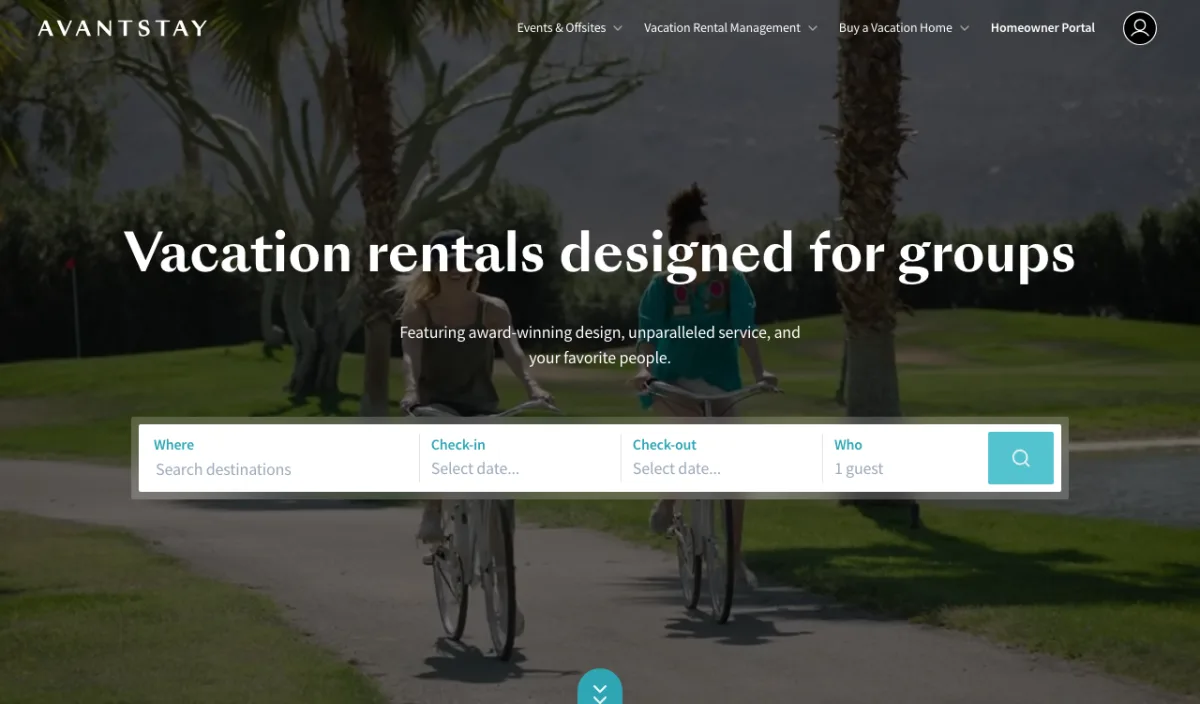
Best for: Portfolio operators with 10+ premium units in vacation markets who value tech, design, and an integrated experience.
Typical fee: Approximately 25-30% of gross booking revenue, varying by market, property quality, and the scope of design and capital services included.
Services and specialties:
- Tech-forward operational stack with in-house pricing technology
- Integrated design services for properties under management; AvantStay-managed homes often go through a brand-aligned design refresh
- Portfolio focus, with a typical 10+ unit minimum
- Concentration in vacation destinations: ski markets, beach markets, lake markets, and the higher-end leisure-travel category
- Strong direct-booking and brand presence in target markets
What makes AvantStay different: Among the full-service managers in this list, AvantStay has invested most visibly in a coherent brand experience and a vertically integrated tech and design stack. For portfolio operators who want their properties to look and feel like a curated brand rather than a generic rental, AvantStay’s design eye and tech infrastructure are genuine differentiators. The portfolio focus also means owners are unlikely to be treated as a peripheral account; the AvantStay model is built around scale on the owner side, not just the manager side.
Honest limitations:
- Geographic coverage is concentrated in vacation markets; AvantStay is not a fit for urban primary-residence markets or for owners outside the destination categories AvantStay targets
- The 10+ unit minimum rules out most individual hosts; the model is not designed for one-or-two-property owners
- Premium positioning means premium pricing — fees and minimums sit at the higher end of the category
- Verify the current portfolio minimum, target markets, and the specifics of the design-and-capital scope in discovery
6.3 Vacasa


Best for: Owners wanting the largest US full-service vacation rental platform, the deepest operational infrastructure, and a single national vendor across multiple markets.
Quick facts: Founded 2009 in Portland, Oregon. Manages 38,000+ homes across 41 U.S. states plus Canada, Mexico, Belize, and Costa Rica. Went public via SPAC December 2021 (NASDAQ: VCSA), acquired by Casago and delisted on April 30, 2025 at $5.30/share (~$128M total deal value). Casago (the acquirer) was founded 2001 and ran ~5,000 properties pre-merger across the U.S., Mexico, Costa Rica, and the Caribbean. Sources: vacasa.com/about, BusinessWire 2025-03-17.
Typical fee: Approximately 25-35% of gross booking revenue, with the actual rate depending on market, property type, services included, and contract terms. The Vacasa fee is widely discussed in owner forums and the 25-35% range is consistent with what most owners report after publishing their actual numbers. Post-Casago, fee structure has not yet been publicly reset — confirm in discovery.
Services and specialties:
- National coverage across most major US vacation markets, with operational density that few competitors can match
- In-house revenue management team with proprietary tooling layered onto industry-standard inputs
- End-to-end operational stack: guest communication, cleaning, maintenance, channel management, and reporting
- The largest single platform in the category by managed-unit count
- Acquired TurnKey Vacation Rentals in 2021, consolidating tech-forward mid-market inventory
What makes Vacasa different: Scale, full stop. Vacasa runs at a unit count no one else in this category approaches, which gives them operational density, market data depth, vendor relationships across cleaning and maintenance, and a hiring base that smaller competitors cannot easily match. For an owner who values the assurance of a large, well-resourced vendor, Vacasa is the default choice. The trade-off is that scale produces averaging — the same standardization that delivers consistency across forty thousand units also makes it hard for any individual property to receive distinctive strategic attention.
Honest limitations:
- Owner-reported revenue performance is mixed; some report strong results, others report being out-paced by their comp set despite Vacasa’s resources
- Pricing methodology transparency is limited; owners typically receive monthly statements without the underlying pricing logic visible
- Fee structure sits at the high end of the category, which compresses the math for owners with already-strong operations
- Reports of inconsistent unit-level attention are common in owner communities, particularly for single-property owners in non-flagship markets
- Customer service responsiveness varies by region
6.4 Evolve


Best for: Hands-on owners across a broad US market footprint who want dynamic pricing and channel management included in a lower-fee co-host arrangement.
Typical fee: Approximately 10% of bookings under the standard Evolve co-host model, meaningfully lower than the full-service category average. Confirm the current rate and any market-specific variations in discovery.
Services and specialties:
- Co-host operating model: Evolve handles listing distribution across major OTAs, dynamic pricing, and the booking pipeline; the owner is responsible for, or directly contracts, more of the operational layers than at a traditional full-service manager
- Centralized dynamic pricing managed by Evolve’s internal revenue team and tools
- Broad US geographic coverage, including markets that boutique vendors don’t enter
- Channel management across Airbnb, Vrbo, Booking.com, and direct channels
- Lower-touch model designed for owners willing to do part of the work themselves
What makes Evolve different: Evolve’s lower fee is the headline, but the structural choice underneath it is what matters. By keeping cleaning, maintenance vendor relationships, and on-the-ground operations partially or fully with the owner, Evolve avoids the cost layers that drive Vacasa and AvantStay fees to 25-35%. For an owner who is comfortable contracting cleaners directly and being reachable for operational issues, the math can be genuinely better than a traditional full-service arrangement. For an owner who hired a property manager specifically to avoid those responsibilities, Evolve will feel like a half-measure.
Honest limitations:
- The co-host model is not a true full-service handoff; expect to retain real operational responsibilities and to be available for issues that more comprehensive managers would handle directly
- Pricing is centralized, which can leave individual properties under-tuned compared with a dedicated revenue manager working a smaller book
- Service-quality reports vary; the broad geographic footprint produces some inconsistency in local execution
- The lower fee is genuine value for the right owner profile and a poor fit for owners who expected a turn-key experience
6.5 iTrip


Best for: Owners in markets with a strong, well-run local iTrip franchise who value local market intelligence applied through a national tech stack.
Typical fee: Variable by franchise. The franchise model means each location sets its own fee structure within network guidelines; expect a range broadly consistent with the rest of the full-service category.
Services and specialties:
- Franchise-based network of locally owned vacation rental management businesses
- Shared national technology stack: PMS, channel management, pricing tools, and reporting infrastructure
- Locally owned and operated franchises that provide market-specific knowledge
- Combined national tools with local execution
- Wide geographic distribution across US vacation markets
What makes iTrip different: The franchise model is genuinely different from the centralized models at Vacasa, AvantStay, Evolve, and Awning. In a strong iTrip market, the local franchisee is a small-business owner with deep market knowledge, established cleaner and maintenance vendor relationships, and direct accountability to their owner clients. The national tech and brand support give them tools and reach that a fully independent local manager would struggle to replicate. The combination, when it works, is one of the best operational fits in the category.
Honest limitations:
- Quality varies meaningfully by franchise; the brand-level pitch is less predictive of your experience than the specific franchisee’s track record
- Do detailed reference checks with current owner clients of the specific local franchise, not the brand at large
- Pricing methodology rigor varies by franchise; some run disciplined pricing, others rely heavily on the default tooling without much human oversight
- If the strong local franchise in your market exits the network or sells to a different operator, your service experience can change abruptly
6.6 Roami

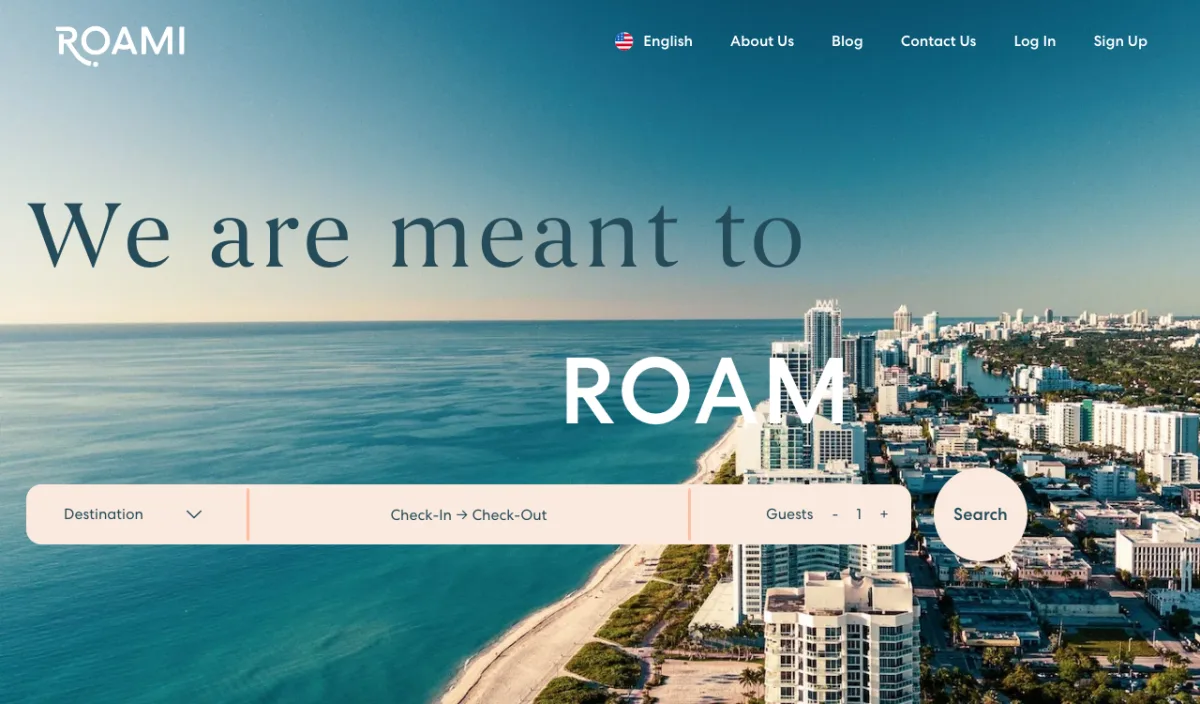
Best for: Owners in select urban and leisure markets who want a boutique full-service relationship with higher-touch attention than enterprise vendors typically provide.
Typical fee: On request. Roami’s pricing structure is not publicly listed and varies by market and property profile. Confirm in discovery.
Services and specialties:
- Boutique full-service property management in select urban and leisure markets
- Higher-touch operational model with smaller per-manager portfolios
- Curated property selection rather than indiscriminate market coverage
- Focus on guest experience and brand consistency within the portfolio
- Geographic footprint is intentionally limited
What makes Roami different: Where Vacasa optimizes for scale and AvantStay for portfolio operators in vacation markets, Roami optimizes for boutique attention in markets where consistent quality and brand experience translate into rate premiums. For owners in markets that fit Roami’s footprint and whose properties fit the brand profile, the higher-touch model can outperform larger managers on rate, occupancy, and guest review quality. The boutique scale is also the model’s constraint: Roami is not a national fit and will not pretend to be one.
Honest limitations:
- Geographic coverage is the binding constraint; if your property is outside Roami’s market footprint, the model isn’t available
- Pricing is opaque; expect a discovery conversation to surface the actual fee structure
- The boutique scale means less infrastructure depth than at Vacasa or AvantStay, which can matter in operational stress scenarios
- Verify the specifics of the market coverage, property profile fit, and service-level commitments before signing
Honorable Mentions and Regional Players
The vendors above are the most commonly evaluated names in the full-service-with-dynamic-pricing category, but the category is broader than the marketed leaders. Casago and Sextant Stays are full-service vendors with regional strength in specific markets and warrant evaluation if they operate in your geography. Local independent property managers are often overlooked and frequently outperform national vendors on rate and occupancy in markets where local knowledge is determinative. The right discovery question for a local manager is the same as for a national one: what is the pricing methodology, who runs it, and how often does it get reviewed for my specific property?
What’s Not a Property Manager (and Why It Matters)
Two categories of vendor commonly show up in research for “full-service Airbnb management with dynamic pricing” but don’t actually belong in this list. Both deserve clarification because confusing them costs owners discovery calls and sometimes contracts.
Hostfully is a property management system (PMS), not a property management company. Hostfully sells software that helps an operator run their own properties: PMS functionality, channel management, guest messaging templates, and reporting. Hostfully does not run properties on the owner’s behalf. The similar name is the source of frequent confusion. If you’re looking for a full-service manager, Hostfully is not in this category. If you’re looking for PMS software, Hostfully is a strong product to evaluate alongside Guesty, Hostaway, OwnerRez, and Lodgify.
Rented (now part of TravelNet) is a managed revenue management service, not a full-service property manager. Rented handles pricing strategy and execution for professional property managers and larger operators; it does not handle cleaning, guest communication, maintenance, or other operational layers. Rented appears in our best STR revenue management companies of 2026 listicle, which is the right place to evaluate it. In this article, it is mentioned only to clarify that it is not a full-service property manager and does not belong in this comparison.
Pure dynamic pricing tools like PriceLabs, Beyond Pricing, Wheelhouse, Quibble, and RoomPriceGenie are software products, not management services. They automate the mechanics of rate adjustment within rules the operator configures. They do not run the property or set strategy on the operator’s behalf. For an introduction to how these tools work and where they fit, see our dynamic pricing guide for STR beginners. The discipline of constructing the comp set those tools actually price against is documented in how to build a comp set.
Common Mistakes Operators Make When Choosing a Full-Service Property Manager
Eight years of watching this category from inside operations and inside pricing produces a recurring list of mistakes. They are not mysterious. They are simply easier to avoid before signing than after.
- Treating the fee percentage as the primary comparison metric. A 22% fee paired with weak pricing methodology and opaque reporting is more expensive than a 28% fee paired with disciplined pricing and visible logic. The headline number is the easiest variable to compare and the least informative.
- Not asking who actually manages pricing on your property. “Our team manages your pricing” is a different answer than “Mike, our revenue manager for your region, reviews your calendar every Tuesday morning.” Push for the specific.
- Skipping the pricing-methodology question entirely. Most owners don’t ask. The vendors who would have given useful answers and the vendors who would have given evasive answers end up looking identical in the discovery call, and the difference shows up two years into the relationship.
- Assuming “dynamic pricing included” means active pricing management. Many full-service vendors set up a pricing tool, configure baseline rules, and walk away. Active management — daily or weekly attention from a human being who knows your property — is a different service than running an algorithm on default settings.
- Not asking for owner-reference contacts. Reference checks with current and recent owner clients surface more information in twenty minutes than any number of sales calls. Specifically ask about pricing performance versus market, reporting quality, and responsiveness during operational issues.
- Ignoring portfolio fit. A national manager who runs forty thousand units may give your single property less attention than a regional manager with two hundred. Sometimes that’s the right trade-off. Sometimes it isn’t. The point is to make the trade-off consciously rather than by default.
- Locking into long contracts without an out clause. Many full-service agreements run twelve or twenty-four months. Negotiate for a defined performance review at six months with an exit option if revenue performance falls short of a documented benchmark. The vendor’s willingness or refusal to discuss this is itself useful information.
- Confusing convenience with optimization. Convenience is a real value. It is not the same as optimization. The owner who realizes, three years in, that they were paying 28% of gross revenue for convenience when their actual gap was pricing has bought one thing and wanted another. The framework in §4 exists to prevent that outcome.

“The frameworks behind this article were developed across the 198 listings RevFactor manages — 24 U.S. states, 67 markets, with a documented +24% RevPAR lift versus comp set.”
Federico Zimerman
When to Choose RevFactor (Model 2) Instead
A direct, transparent positioning section. If you are an owner reading this far into a comparison of full-service property managers, there’s a non-trivial chance you came in looking for one solution and are starting to realize you might need another. This section is for that reader.
Choose a full-service property manager (Model 3) if:
You want a genuine hands-off relationship. You’re comfortable paying 15-35% of gross revenue to consolidate every operational layer under one vendor. You do not have the time, interest, or experience to run operations yourself and have no desire to develop those skills. The convenience is worth the fee, and the pricing methodology, while important, is not your primary lens for evaluating value.
Choose RevFactor (Model 2 — managed revenue management) if:
You already run operations well, or have the resources to contract operational services directly. Your gap is specifically pricing. You want a specialist actively managing your calendar, watching pacing, making rate calls, and tuning minimum stays — but you want to retain operational control and you don’t want to pay a percentage of gross revenue for layers you don’t need.
RevFactor manages revenue only — pricing strategy, calendar management, minimum stays, length-of-stay rules, and pacing oversight. We do not handle cleaning, guest messaging, maintenance, or OTA listings. The buyer profile is the hands-on STR operator running 3-15 properties who wants the pricing discipline of a full-service manager’s best in-house revenue team, without the operational handoff and without paying a percentage of gross.
We charge a flat $350 per month per property — the same price across 1–5 properties — plus a one-time $150 onboarding fee. Portfolios past 5 properties get enterprise pricing. The fee schedule is published on our site, which is unusual in this category and intentional. The frameworks we apply were developed and stress-tested across the 198 listings RevFactor manages — 24 U.S. states, 67 markets, with a documented +24% RevPAR lift versus comp set across the portfolio. Founder Federico Zimerman spent ten years in airline yield management at American Airlines before moving into short-term rentals; airline yield management is the original discipline that modern STR dynamic pricing is built on top of.
The honest cost comparison. For a property generating $80,000 in annual gross revenue, a 25% full-service fee is $20,000. RevFactor’s flat fee for a single property is $4,200 per year. The math doesn’t favor RevFactor if you genuinely need operational management — that gap exists because RevFactor doesn’t provide operational management. The math favors RevFactor decisively if you can handle operations yourself and your gap is the pricing layer specifically.
Honest limitation. RevFactor was founded in June 2025. The track record is real but short by comparison with Vacasa, Evolve, or Awning. Our tenure in the managed RM category is among the longer ones, but the company itself is young. We disclose this directly in every discovery call.
For the methodology behind how we work, see The RevFactor Method. If you want to walk through the math on your specific portfolio, start a conversation.

“The right question is not which property manager is best. It’s which model is right for the way you actually want to operate.”
— Federico Zimerman
Coverage Map: Which Full-Service Property Managers Operate Where
The six vendors profiled above split into national, multi-region, and regional footprints. The fee math only works if the manager has real density in your market — a national brand with one cabin in your county will not out-execute a regional operator with thirty.
| Manager | National scale | Mountain + cabin markets (Smokies, Blue Ridge, Big Bear, Park City) | Beach + coastal (Destin, Hilton Head Island, Gulf, Carolinas) | Urban (Chicago, NYC, LA, Miami metros) | Hill Country + Texas leisure |
|---|---|---|---|---|---|
| Awning | West Coast + select metros | ✓ Lake Tahoe, Big Bear, mountain markets | Limited | ✓ Urban West Coast focus | Limited |
| AvantStay | Concentrated in vacation markets | ✓ Premium mountain & ski | ✓ Premium coastal | Limited | ✓ Hill Country premium |
| Vacasa | ✓ Deepest US footprint | ✓ Smokies, Blue Ridge, Lake Tahoe, Big Bear | ✓ Gulf coast, Outer Banks, Hilton Head | Limited | ✓ Hill Country, Galveston |
| Evolve | ✓ Broad US co-host coverage | ✓ Cabin economy | ✓ Beach & coastal | Limited urban | ✓ Texas leisure |
| iTrip | Franchise-dependent | Where franchises exist | Where franchises exist | Where franchises exist | Where franchises exist |
| Roami | Select urban + leisure | Boutique mountain only | Boutique coastal | ✓ Urban leisure | Limited |
What this table actually answers is “which of these managers has 50+ comparable units in my submarket” — the implicit threshold below which the pricing methodology starts to thin. For markets like Gatlinburg (the densest STR market in the country at ~3,600 active listings per AirROI), every national manager has meaningful inventory. For markets like Joshua Tree (~1,200 listings) or Fredericksburg, TX (~2,100 listings), the answer narrows considerably.
For California and Texas specifically — the two states with the most “near [state]” searches — Vacasa, AvantStay, and Evolve all run portfolios at scale. The differentiator is not whether they operate there but how many comparable properties they currently price in your specific submarket. Ask the vendor for that count by ZIP code before signing.
The Bottom Line: Pick the Model Before You Pick the Manager
Full-service property management is a legitimate, valuable, well-developed category for owners who genuinely want a hands-off relationship with their short-term rental. Vacasa, AvantStay, Evolve, Awning, iTrip, and Roami all serve real operator profiles, and each one is the right answer for a specific kind of owner.
The mistake most owners make is signing into a 25-35% fee structure before asking whether their actual gap was operational or pricing-specific. For owners whose operations are weak, paying for operational consolidation is genuinely worth it. For owners whose operations are strong and whose gap is pricing, paying 25-35% to professionalize the operational layer they already handle well, while accepting an averaged-out pricing methodology in the bundle, is the most common expensive mistake in this category.
The first step is the model. Once the model is settled, the vendor choice is a much more bounded problem. The framework in §4 and the evaluation criteria in §5 are how to make that choice deliberately rather than by default.
If you’ve read this far and your operations are already running well, the more interesting comparison is the one with the best STR revenue management companies of 2026 — the Model 2 specialists who professionalize pricing without bundling operations. That’s where most operators with strong execution and a pricing-shaped gap end up.
If your situation is the opposite, where operations are the gap and pricing is incidental, pick the full-service manager from the list above whose markets, portfolio profile, and methodology disclosure best fit your situation, and do reference checks before you sign.
Either way, the framework matters more than any one vendor. Pick the model first. The rest follows.
Frequently Asked Questions
What is the best property management company for Airbnb with dynamic pricing?
What is the difference between a full-service property manager and a managed revenue management service?
How much does a full-service Airbnb property manager cost?
Is Vacasa or AvantStay better?
Does Evolve offer dynamic pricing?
Is Awning a legit property management company?
What happened to TurnKey Vacation Rentals?
What is the iTrip franchise model?
What is the difference between a property management company and a property management system (PMS)?
When should I hire a property manager instead of a revenue manager?
Are full-service property managers worth the fee?
Can I switch from a full-service property manager to managing the property myself?
How much should I pay an Airbnb property manager?
What is the 75-55 rule for Airbnb?
What is the 80/20 rule for Airbnb?
Which Airbnb property managers offer dynamic pricing?
federico zimerman
Federico Zimerman is the founder of RevFactor, a managed revenue management service for short-term rental hosts. He spent 10 years in airline revenue management at American Airlines before applying that yield-management playbook to vacation rentals — strategies that run daily across 198 STR listings in 24 U.S. states and 67 markets through Blackbird Hospitality, with a documented +24% RevPAR lift vs. comp set.
He's been featured on No Vacancy with Natalie Palmer (Ep. 155), Life of Flow (Ep. 93), Crafted Stays, and STR Like The Best (Ep. 54), and posts daily on TikTok (@federicozimerman) and Instagram (@federico.zimerman).
Read more from the Journal.



Ready to optimize your revenue?
Let's talk about your properties.
Schedule a free 30-minute discovery call to see what expert revenue management could do for your STR portfolio.