

Best Airbnb & STR Revenue Management Companies and Tools (2026)
Most comparisons sort vendors by business model. This one scores them on what moves a calendar, sorts the market with the Three Models framework, and tells you when a $20 tool is the right answer.

In this essay · 21 sections
- 01 Key Takeaways
- 02 How We Ranked Them
- 03 Are There Companies That Handle Pricing for Vacation Rentals? The 6 Best at a Glance
- 04 1. RevFactor
- 05 2. Pacer
- 06 3. Hostlyft
- 07 4. PriceLabs
- 08 5. Wheelhouse
- 09 6. Beyond
- 10 Show Up in This Search but Are Not Revenue Management
- 11 Who Dropped Off This List
- 12 Full-Service Property Management, a Different Purchase
- 13 What This Actually Costs, Side by Side
- 14 What Services Optimize Short-Term Rental Performance? The Seven Levers That Decide
- 15 Who Can Manage My Dynamic Pricing for Vacation Rentals? The Three Models
- 16 Geographic Coverage: Which Vendors Operate Where
- 17 When to Switch From a DIY Tool to a Managed Service
- 18 Common Mistakes Hosts Make When Choosing a Revenue Management Provider
- 19 What Companies Help Airbnb Hosts Earn More Per Night? What the First-Party Numbers Show
- 20 Score Your Own Calendar Before You Buy Anything
- 21 What Companies Will Manage My Vacation Rental Pricing? How to Actually Choose
QUICK ANSWER
The best Airbnb or STR revenue management company depends on which of seven levers is leaking on your calendar, not on which vendor has the best website. Dynamic pricing software (PriceLabs, Wheelhouse, Beyond) automates rate and rules and pulls two levers well. A managed revenue management service (RevFactor, Pacer, Hostlyft) owns the five judgment calls software cannot make. Full-service property management adds operations at a much higher cost. Diagnose the lever first, then pick the category, then pick the vendor.
Summer Revenue Ahead of Prior Year
+$139,580
across 7 published case studies · on-the-books vs same time last year
Largest Single-Property Gain
+$47,459
a 6BR Gatlinburg cabin · 2.8 months after onboarding
RevPAR Versus Comp Set
+24%
198 listings · 67 markets · 24 U.S. states
Key Takeaways
- The best pick is the one that fixes the lever your calendar is getting wrong, not the one with the best website. For some operators a $20 tool is the correct purchase and paying anyone $350 a month is waste.
- Best managed service: RevFactor, for owners who want the seven levers run without handing over the whole property. Best for portfolios: Pacer, aimed at property managers running 20+ units. Best DIY software: PriceLabs, the engine most professional operators already run.
- Seven levers move a calendar. Software pulls two of them well. The other five are judgment calls, which is the entire reason the managed category exists.
- The Three Models framework (Software, Managed RM, Bundled PM) sorts the same market a second way, by who holds the strategy. Get the model right before you get the vendor right.
- Airbnb hands you your competitors’ booked and unbooked rates for free, inside your own calendar, and almost nobody opens it.
- Two names you may still see in older lists are gone: STR Consulting now redirects to Pacer, and RevPARTY Consulting’s site is offline. Freshness matters in this category.
- RevFactor appears in this list and we score ourselves by the same published rubric, in full below.
How We Ranked Them
We scored every vendor on the seven levers that actually move a calendar, weighted: gap nights 20%, comp-set truth 15%, conversion funnel 15%, minimum stay 15%, update cadence 15%, launch sequencing 10%, fee structure 10%. Then three tiebreakers: commercial-terms transparency, verifiable results, and independent review volume.
Data sources: each vendor’s own live pricing page, checked on August 4, 2026; review score and volume from Capterra, G2 and Trustpilot; and RevFactor’s first-party managed-book plus seven published case studies. Where a company does not publish a number, we say so rather than guess, because the opacity is itself part of what you are evaluating.
Honest methodology
1 of 6
Vendors on this list whose numbers are first-party and audited: ours
We are in our own list, and the data is not symmetrical
RevFactor appears in a list RevFactor published. Stating that plainly is more useful than a disclaimer at the bottom. No vendor paid for placement. What we scored is whether a vendor can pull each of the seven levers and on what commercial terms. What we did not score is service quality or results, because we cannot audit a competitor’s outcomes and neither can you from the outside.
Are There Companies That Handle Pricing for Vacation Rentals? The 6 Best at a Glance
Yes, and they split into two categories that are often sold as one. Managed services put a person on your calendar: RevFactor, Pacer and Hostlyft. Pricing software gives you the engine and leaves the decisions to you: PriceLabs, Wheelhouse and Beyond. Every figure below was checked against the vendor’s own live page on August 4, 2026, and the Pacer and Hostlyft rows were rechecked on September 16, 2026. “Levers” is how many of the seven a vendor can actually pull, out of 7.
| # | Company | Type | Best for | Starting price | Reviews (score / volume) | Levers |
|---|---|---|---|---|---|---|
| 1 | RevFactor | Managed service | The 7 levers run for you, short of full PM | $350/mo flat + $150 onboarding | First-party (198-listing book) | 7 / 7 |
| 2 | Pacer | Managed (portfolios) | Property managers running 20+ units | Custom, not published | None public | 7 / 7 |
| 3 | Hostlyft | Managed service | Portfolios of 10+ units, with a smaller-portfolio track | $140 per unit per month at 1 to 2 units, down to $60 at 10 to 19 | None public | 7 / 7 |
| 4 | PriceLabs | Pricing software | DIY operators in a known market | $19.99 / listing / mo | Capterra 4.9 / 250 | 2 / 7 |
| 5 | Wheelhouse | Pricing software | Flexible pricing-model choice | $19.99 / listing / mo | Capterra 4.8 / 162 | 2 / 7 |
| 6 | Beyond | Pricing software | A percentage-of-bookings model | 1% to 1.25% of bookings | G2 4.7 / 150 | 2 / 7 |
Two names that dominate these search results, AirDNA and Key Data, are market-data platforms at their core, and we cover why below, including the pricing tool AirDNA launched in September 2026. Full-service property managers (Vacasa, Evolve, Awning) are a different purchase and sit in their own list. If you own one to five properties and only want the managed services compared, seven of them are scored in the best Airbnb revenue management services for hosts with 1 to 5 properties.
1. RevFactor


Best for: owners who want all seven levers run by a specialist without handing over cleaning, guest comms and the rest of the business.
RevFactor is revenue-only management: a specialist prices your calendar, sets minimum stays, reads pacing weekly and shapes the booking curve, while you keep operations. Pricing is a flat $350/month per property for one to five properties, plus $150 one-time onboarding and $50/month per child listing, with no volume discount. The fee is flat rather than a share of revenue on purpose, because a percentage creates a quiet pull toward higher ADR even when occupancy would earn more. The managed book is 198 listings across 67 markets and 24 U.S. states, running +24% RevPAR against comp set on a rolling basis, and the case-study results below are first-party rather than self-reported, with the per-property monthly data published in RevFactor’s case studies. Founder Federico Zimerman spent 10 years in yield management at American Airlines before moving into STR, which is the original discipline modern dynamic pricing is built on.
- Pros: covers all seven levers including the judgment calls; flat fee with no incentive skew; first-party audited results; weekly pacing review.
- Cons: roughly six times the cost of the priciest tool, so it is genuine waste for a single well-run listing in a market you know.
- Levers pulled: 7 of 7. Start a conversation with RevFactor.
2. Pacer


Best for: property managers and boutique operators running roughly 10 to 200 units.
Pacer is done-for-you, fractional revenue management aimed at portfolios rather than individual owners, with human revenue managers plus automation operating your pricing tools daily. It was previously STR Consulting and rebranded to Pacer in 2025, and it now describes itself, verbatim on its homepage, as the exclusive revenue management partner of Key Data, claiming a +21% first-year RevPAR lift, measured same-store across its first-year clients. Pricing is not published as numbers, but the structure is disclosed: a flat monthly fee per unit, or a percentage of revenue for larger portfolios, customized per portfolio with no setup fee and no long-term contract.
- Pros: built for portfolios; no long-term contract; Key Data as the underlying benchmarking layer.
- Cons: its homepage targets property managers running 20+ units; pricing is opaque; the brand is young under its current name.
- Levers pulled: 7 of 7 at portfolio scale. pacerrev.com
3. Hostlyft

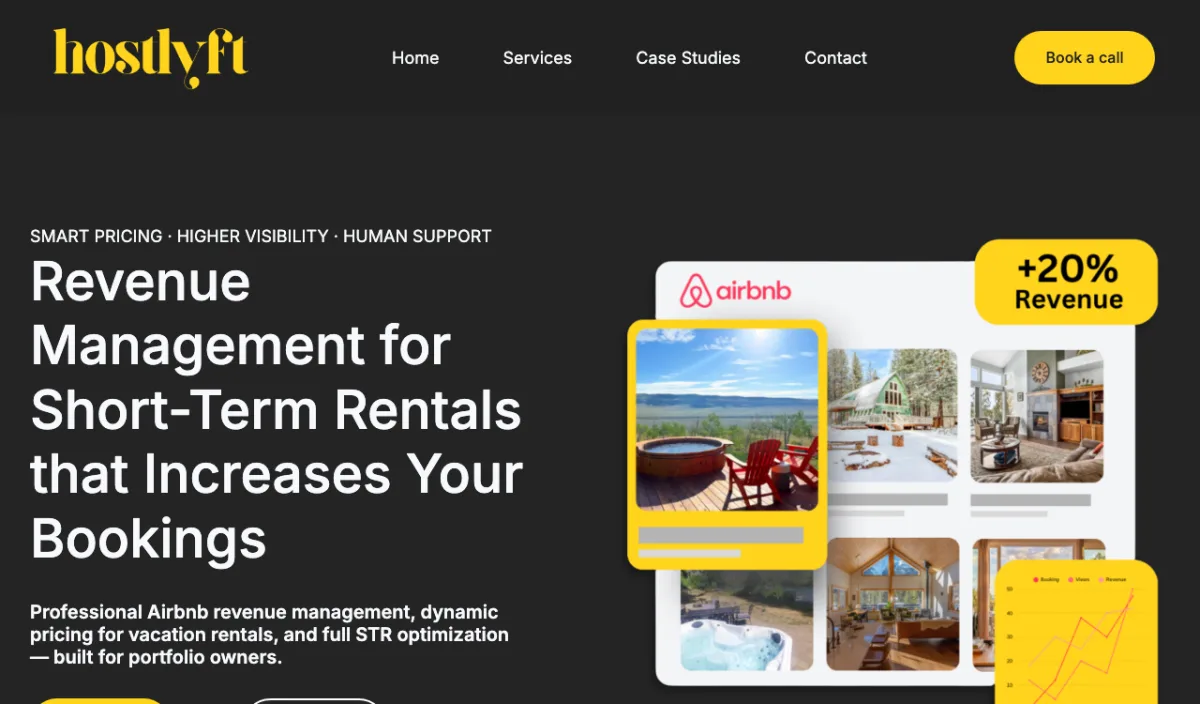
Best for: owners of 10+ units who want pricing and listing work from human specialists, with a published per-unit price.
Hostlyft is a managed service with named revenue managers doing daily rate adjustments, event rules, gap-filling, OTA promotions and weekly reviews across Airbnb, Vrbo and Booking.com. It also sells PriceLabs configuration as a standalone service, which tells you the engine underneath. It operates across Dubai, Europe and the US. Its homepage says it is built for 10+ unit portfolios, with a separate track for owners under 10 units. Pricing is published per unit per month with no setup fee and month-to-month terms: $140 at 1 to 2 units, $90 at 3 to 4, $70 at 5 to 9 and $60 at 10 to 19, with a revenue-share option from 10 units (checked on hostlyft.com/pricing, September 16, 2026).
- Pros: human specialists; cross-OTA management; published per-unit pricing with no setup fee; month to month.
- Cons: positioned for 10+ unit portfolios, so smaller owners go through a separate track; a thin public track record with no third-party reviews found; self-reported results only.
- Levers pulled: 7 of 7. hostlyft.com
4. PriceLabs
Best for: DIY operators pricing one or two properties in a market they already understand.
PriceLabs is the engine most professional operators run, and the one whose own documentation states the gap-night mechanism plainly. Founded in 2014 and based in Chicago, it now prices 600,000+ properties daily for 60,000+ hosts across 150+ countries, and carries the deepest verified review footprint in the category at 4.9 on Capterra across 250 reviews. Pricing is $19.99 per listing per month in the US, UK, Canada, Europe, Australia, New Zealand and Israel, discounted on a sliding scale from the second listing, with a $9.99 rate for much of the rest of the world and a 1% of booking revenue plan if you prefer that shape. Extra daily syncs are $1 per listing per month, and there is a 30-day free trial with no card required.
- Pros: the deepest rule set; huge adoption; genuinely cheap; free trial.
- Cons: it executes a strategy, it does not set one, and it cannot see your conversion funnel.
- Levers pulled: 2 of 7. hello.pricelabs.co
5. Wheelhouse
Best for: operators who want to choose their pricing-model shape rather than be locked into one.
Wheelhouse, also founded in 2014 and based in San Francisco, rates strongly with users at 4.8 on Capterra across 162 reviews and 4.9 on G2 across 88. It offers Pro Flat at $19.99 per listing per month at any portfolio size, discounted 15% to $16.99 between 10 and 49 listings with 50 or more quoted by sales, or Pro Flex at 1% of revenue with a $2.99 monthly minimum, billed at time of reservation and refunded on cancellation. Dynamic Sets, the mapping and set-management interface, is $12.99 per set per month. It does not offer a done-for-you service in which a specialist runs your calendar.
- Pros: flat or percentage choice; strong ratings; flexible set management.
- Cons: no managed option; the same judgment gap every tool has.
- Levers pulled: 2 of 7. usewheelhouse.com · head-to-head against PriceLabs and a managed service in PriceLabs vs Wheelhouse vs a done-for-you service
6. Beyond

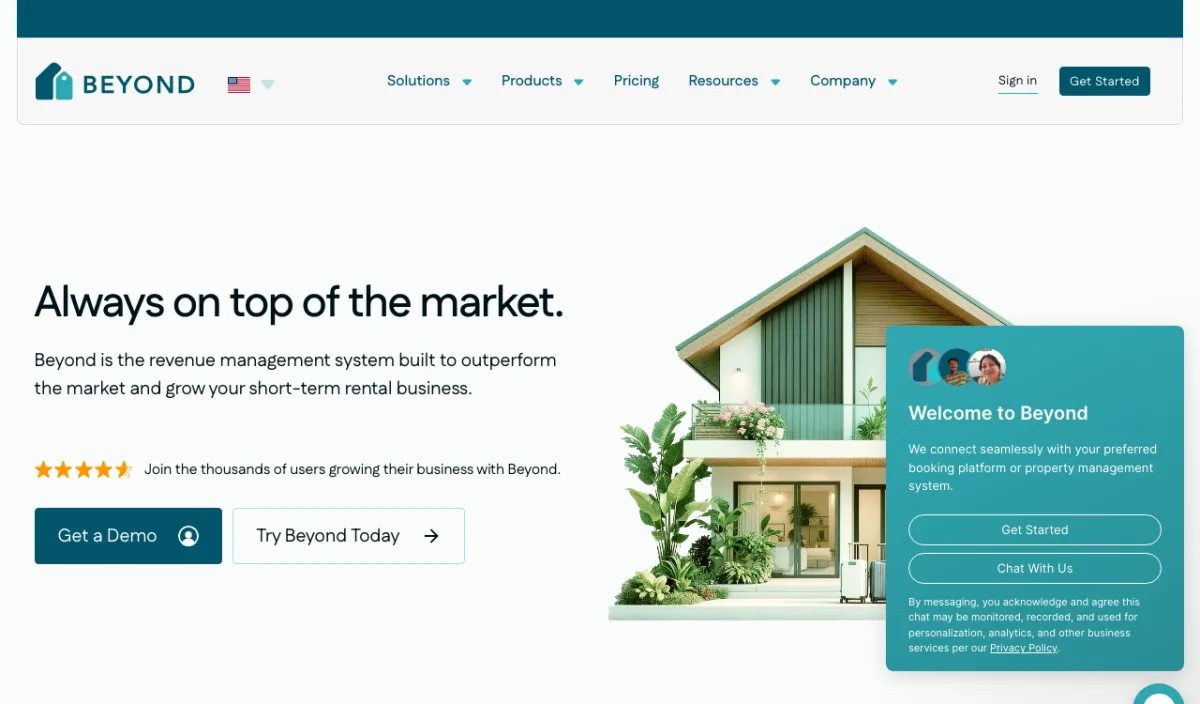
Best for: operators who specifically prefer a percentage-of-bookings model over a flat software fee.
Beyond, founded in 2013 in San Francisco, prices 340,000+ listings across 7,500+ cities and reviews well at 4.7 on G2 across 150 reviews. It is now priced purely as a share of bookings: Growth at 1% and Pro at 1.25%, where Pro adds search-powered pricing, custom comp sets and owner reporting. Worth being precise about, because older comparisons get it wrong: dedicated revenue managers are not part of the Pro tier. They are a separate add-on called Guidance, sold through sales. Pro is the software with more features, not a managed service.
- Pros: broad platform with insights and direct-booking tools; strong review volume.
- Cons: a percentage on all bookings gets expensive on a strong property; Pro is regularly mistaken for a managed service.
- Levers pulled: 2 of 7. beyondpricing.com
Show Up in This Search but Are Not Revenue Management
These names rank for “best Airbnb revenue management” and are worth knowing. Their core products do not price or manage a calendar and pull zero of the seven levers, so they belong in your toolkit rather than on your shortlist of managers. AirDNA is now a partial exception, explained in its entry.
- AirDNA is the market-data platform most operators use for comps and acquisition research. Founded in 2015 and based in Denver, it tracks 15M+ active short-term rental listings across 120,000+ markets, according to AirDNA’s Adapt page and sits at about 4.0 on Trustpilot across 942 reviews, with sentiment notably mixed on billing. The research platform informs pricing decisions without making them. That changed at the product level in September 2026, when Skift reported AirDNA’s entry into revenue management with Adapt, a dynamic pricing tool priced at $20 per listing per month with a 30-day free trial and four named pricing strategies. Adapt is software you run yourself, so on this rubric it belongs in the pricing software tier beside PriceLabs, Wheelhouse and Beyond at 2 of 7 levers. It has too little public track record yet to rank, and we will score it once it does. airdna.co/adapt
- Key Data is a benchmarking and business-intelligence platform, founded in 2018 in Santa Rosa Beach, Florida, covering 500+ markets. It is the data layer behind Pacer’s managed service. Analytics only, no pricing or management, and almost no public review signal to check. keydatadashboard.com
- Hostaway is a property management system and channel manager, not a revenue management service. It syncs your listings, messaging and calendars across Airbnb, Vrbo and Booking.com and connects to a pricing tool like PriceLabs, but it does not price your calendar or make a single rate call for you. A PMS belongs in your operations stack, not on your revenue-management shortlist. hostaway.com
- DPGO, Quibble and Rankbreeze also surface in this search. DPGO and Quibble are AI dynamic-pricing tools in the same category as PriceLabs and Wheelhouse, genuinely useful software you still run yourself; Rankbreeze is a listing-optimization and ranking tracker. Useful, but none of the three is a managed revenue management service.
Who Dropped Off This List
Two names appear in older comparisons and should not be in yours.
- STR Consulting is no longer independent. As of this check, strconsulting.io returns a live 301 redirect to Pacer, and the Key Data partnership it once held now sits with Pacer. If a list still shows them separately, that list is stale.
- RevPARTY Consulting has no working website. The domain does not resolve at the DNS level as of this check, with only a lingering LinkedIn page still visible. Draw your own conclusion about handing your calendar to a vendor with no live site.
Full-Service Property Management, a Different Purchase
If you want to delegate everything, not just pricing, full-service managers bundle pricing with cleaning, guest communication and maintenance at a much larger share of gross revenue. That is a different economic logic, and I compare those vendors in the full-service property manager list. For orientation:
- Evolve (founded 2011, Denver) publishes the cleanest number, a flat 10% of booking revenue, manages roughly 24,000 properties and sits at about 3.8 on Trustpilot across 266 reviews.
- Awning (founded 2019) runs closer to 15% of revenue, holds 4.7 on Trustpilot across a low 33 reviews, and was acquired by RedAwning in April 2024.
- Vacasa (founded 2009) was acquired by Casago for about $130M in April 2025 and delisted from the Nasdaq, and is being folded into a franchise model now spanning roughly 43,000 properties. Its Trustpilot score is bimodal, around 4.0 across 16,500+ reviews on one platform and far lower on others, so read the reviews rather than the headline.
What This Actually Costs, Side by Side
The honest comparison nobody in this category publishes. Take a single property doing $70,000 a year in bookings:
- PriceLabs flat: about $240 a year
- Wheelhouse Pro Flat: about $240 a year
- Beyond Growth at 1%: about $700 a year
- AirDNA Adapt: about $240 a year at $20 per listing per month, captured September 14, 2026
- RevFactor: $4,200 a year, plus $150 once
So a managed service costs roughly six times the most expensive tool and about seventeen times the cheapest. That is the real question in front of you, and it is arithmetic rather than opinion: does delegating the seven levers produce more than about $4,000 of additional revenue on that property? On our own published case studies the range ran from +$5,538 to +$47,459 for a single summer, so the answer is defensible. It is not automatic, and any vendor telling you it is automatic is selling.
One pattern worth noticing while you compare quotes. PriceLabs, Wheelhouse and Beyond all now offer a percentage-of-revenue option, and Beyond only prices that way. The incentive argument for a flat fee therefore applies to your tool now, not only to your service.
What Services Optimize Short-Term Rental Performance? The Seven Levers That Decide
Seven things move a short-term rental’s performance, and no single service touches all of them. Rate setting, minimum-stay and inventory rules, comp-set construction, pacing review, event and seasonality forecasting, channel and listing conversion, and reporting that leads with RevPAR. Pricing software reaches three or four of the seven. A managed service reaches all seven because a person is making the calls. The table below scores each vendor out of 7.
Grouped by what actually moves a calendar, rather than by category label. Find the one leaking on your listing, because that determines what you should buy, and it is a different answer for different operators.
The diagnosis
Seven ways to move a calendar
Software pulls two of these well. The other five are judgment calls, which is the entire reason the managed category exists.
1
Comp Set Truth
Which listings Airbnb thinks you compete with
Not the comp set your tool built. The one the platform actually uses when it decides who to show. Airbnb exposes this inside your calendar and hosts rarely look.
2
Conversion Funnel
Impressions, then clicks, then bookings
Three separate failures with three different fixes. High impressions and weak clicks is a price problem. Strong clicks and weak bookings is a listing problem.
3
Minimum Stay
Which searches you show up in at all
A filter, not a preference. Set a five-night floor and you vanish from every shorter search, including the ones your comps are also missing.
4
Launch Sequencing
The first 90 days of a new listing
No reviews, no ranking, no data for anything to learn from. Market penetration is a sequence of decisions, and no tool will make them for you.
5
Update Cadence
How often anyone actually looks
Regular small adjustments beat sophisticated rules left alone. This is the lever most owners lose, and the easiest one to be honest with yourself about.
6
Fee Structure
Who pays the Airbnb commission
Split fee or host-pays-all changes your net per booking. Since search shows total price, the old guest-perception logic for splitting mostly stopped applying.
7
Perishability
Tonight is worth zero tomorrow
Every unsold night expires at zero value, permanently. It is why this discipline came out of airlines, and why waiting to decide is itself a decision.
The comp data Airbnb gives you free
Airbnb tells you what your competitors charge, inside your own calendar, and almost nobody opens it. Highlight at least two vacant nights, open pricing and click Similar Listings. You get the average rate for your listing on those nights, the average rate of comparable listings that booked, and what unbooked listings are still asking. It also reveals which listings Airbnb itself treats as your comp set, which is the one that decides who it shows. A pricing tool builds its own comp set from public data. Only the platform can tell you the comp set it actually uses. The mechanics of how to build a comp set that matches what the platform sees underpin every pricing call downstream of it.
Diagnose the funnel before you touch the rate
Impressions, clicks and bookings fail separately. High first-page impressions with weak click-through means price is filtering people out before they open the listing. Strong click-through with weak booking conversion points at the listing itself, at photos, reviews, minimum stay or fees. Diagnose in that order, because dropping your rate cannot fix a photo problem, and no pricing tool reports this funnel to you. This is the single clearest line between what software does and what a person does.
Where a pricing tool is genuinely enough
A tool is the right purchase when you run one or two properties in a market you know well, your listing already converts, and you genuinely review it every week. If two of those three are true, buy PriceLabs or Wheelhouse and keep the $350. If two of them are false, a better tool will not create the habit or the judgment you are missing, and that is the honest line most comparison lists will not draw for you. If you are still new to the mechanics underneath these tools, our dynamic pricing guide for STR beginners covers what every operator should understand before evaluating providers.
Who Can Manage My Dynamic Pricing for Vacation Rentals? The Three Models
Three kinds of provider can, and the difference is who holds the strategy rather than who owns the software. You can run the tool yourself (PriceLabs, Wheelhouse or Beyond, roughly $20 per listing per month). You can hand pricing to a managed revenue service while keeping your operation (RevFactor at a flat $350 per property per month, Pacer, Hostlyft). Or you can hand the whole property to a full-service manager who prices it as part of a 20% to 40% cut.
The seven levers tell you which capability your calendar is missing. Here is another way to sort the same market, by who holds the strategy. Both lenses point at the same decision from different angles, and the model architecture outlasts any individual vendor. Once you understand the three models, you can evaluate any provider in 2026 or 2030 without needing a comparison article to tell you what to think.
The Three Models
service architecture
Three ways the market answers “who manages your revenue.” Pick the model before you pick the vendor.
01
Software
you drive the tool.
PriceLabs. Beyond. Wheelhouse. ~$20/listing/mo or 1% of revenue. The engine, not the driver.
best for: 1 to 2 listings, 3+ hours/week.
02
Managed RM
done-for-you pricing.
RevFactor. Pacer. Hostlyft. Flat fee or % of revenue. You keep ops; they run pricing.
best for: 3 to 15 listings, control retained.
03
Bundled PM
handed off entirely.
Vacasa. Evolve. Awning. 10 to 40% of gross revenue. Pricing is one of thirty things they do.
best for: hands-off across the business.
Model 1, dynamic pricing software. SaaS platforms that automate rate adjustments from demand signals, comparable listings, event calendars and booking pace. The tool is the engine and someone still has to drive it. It will not catch that your comp set repriced this morning, or that a local event just sold out while your minimum stay blocks the two-night gap. The algorithm is reactive; human judgment applied at the right cadence is additive to any tool.
Model 2, managed revenue management (the done-for-you layer). A specialist decides and executes on your behalf, pricing, calendar shape, minimum stays and pacing, while you keep guests, cleaning and listings. The buyer profile is specific: roughly 3 to 15 properties, wanting the pricing expertise without surrendering operational control or paying a full-service manager a quarter of revenue.
Model 3, full-service property management (revenue management bundled). One vendor decides, executes and handles everything else operationally at 10 to 40% of gross booking revenue. You are buying convenience, not specialization, because revenue management is one of thirty things they do.
SNIPPET DEFINITION
What is a STR revenue management service?
A short-term rental revenue management service is a done-for-you offering in which a specialist manages pricing strategy, calendar availability, minimum-stay rules and length-of-stay decisions on behalf of an STR operator without taking over operational control of the property. The operator keeps responsibility for guests, cleaning and listings; the service handles the revenue discipline. The full discipline is covered in our pillar on revenue management for short-term rentals.
Geographic Coverage: Which Vendors Operate Where
Most managed-RM specialists in this guide operate remotely and engage portfolios anywhere in the U.S. They are not constrained by physical territory the way a regional property manager would be, because the underlying discipline of pricing strategy, comp-set analysis and pacing review is data-driven, not location-driven.
What varies by region is market specialization, and the question worth asking a prospective vendor is not “do you operate in my state” but “how many properties do you currently price in my submarket.”
- California (Big Bear Lake, Joshua Tree, Lake Tahoe, San Diego): most managed-RM specialists (RevFactor, Pacer, Hostlyft) actively price California portfolios. GOPPAR matters more here because cleaning and channel-commission stacks are higher, so ask how a vendor incorporates operating-cost reporting, not just RevPAR.
- Texas (the Hill Country, Galveston, Dallas–Fort Worth, FIFA 2026 host-city markets): most specialists price Texas portfolios. The live differentiator is FIFA 2026 readiness, because a vendor who has already mapped match-day spillover for the U.S. host cities is more useful than one treating summer 2026 as a normal pacing curve.
- The Smoky Mountain corridor (Gatlinburg, Pigeon Forge, Sevierville): the deepest concentration of managed-RM expertise in the U.S. RevFactor’s heaviest portfolio sits here, roughly a $377 average market ADR per AirROI, with top operators clearing well above that.
- Resort and ski markets (Park City, Breckenridge, Big Sky, Hilton Head, Destin): ask specifically about peak-window pricing methodology. These markets concentrate more than half their revenue in 20% of nights, so a vendor without strong peak-window override discipline leaves the most money on the table here.
Most specialists will not publish a state-by-state operating map, but a 15-minute discovery call should produce a real answer to “how many of your current portfolios are in my submarket.” If they cannot answer cleanly, that is the answer.
When to Switch From a DIY Tool to a Managed Service
There is a moment in most operators’ growth when the tool is doing its job and the results still do not feel right. The signals below most consistently precede the switch from DIY software to managed revenue management.
- You have scaled past your third property. One property is manageable with daily attention. Three means three markets, three demand profiles and three calendars to hold in your head at once. The cognitive load compounds nonlinearly.
- You have missed local events more than once. Discovering after the fact that a major event drove a weekend of demand you did not capture because you were not watching pacing early enough is a structural gap a tool will not fix.
- Your calendar has unexplained gaps you cannot diagnose. If you cannot tell whether a gap is a pricing problem, a listing problem, a minimum-stay problem or just market softness, that uncertainty is expensive.
- You are avoiding the dashboard. The most honest signal on this list. When checking your pricing platform feels like a chore you keep deferring, revenue is leaving the table daily.
- RevPAR has plateaued despite a healthy ADR. RevPAR climbing on paper while total seasonal revenue stalls is more common than most operators admit, and an algorithm will not self-diagnose the pricing-mix problem underneath it.
- You are paying for both a pricing tool and a managed service that duplicates it. Some managed providers work on top of your existing PriceLabs subscription; others replace it. Know which model you are buying before you pay twice for the same capability.
- Your comp set is outperforming you and you cannot tell why. If comparable properties consistently run higher occupancy or RevPAR and you cannot identify the structural reason, you need a professional set of eyes, not a better tool.
- You are losing weekend premium because you cannot watch pacing daily. The uplift captured in the final 7 to 10 days before a high-demand weekend requires active monitoring. Miss that window and you leave premium on the table consistently.
Common Mistakes Hosts Make When Choosing a Revenue Management Provider
Vendor selection is full of pitfalls that cost operators real money over the calendar year ahead. The most common, and how to avoid them.
- Confusing pricing tools with revenue managers. A dynamic pricing tool is a calculator. A revenue manager is a strategist. Conflating them leads to systematic underinvestment in real strategy, and is closely related to the ADR vs RevPAR confusion that traps so many operators before they even reach vendor selection.
- Over-indexing on percentage-return promises. A provider who tells you “we will increase your revenue by X%” before looking at your actual data is making a promise they cannot keep. Do not ask for the number; ask what the number is based on.
- Choosing providers without PMS integration. If your managed provider has no working integration with your property management system, you pay the cost of the execution gap between strategy and implementation every week. Confirm compatibility before signing.
- Ignoring track record and verifiable proof. Marketing copy is not proof. Testimonials without specifics, meaning market, property type, baseline and outcome, are not evidence. Ask for written results detailed enough to judge whether the situation resembles yours.
- Expecting passive results from an active discipline. Even the best-run provider needs timely calendar access, prompt communication about property changes and your engagement when they flag a decision. Passive clients get passive results.
- Paying twice for overlapping services. If you already pay for PriceLabs and sign with a provider who uses PriceLabs, clarify who pays for what and whether your subscription folds in or runs in parallel.
- Selecting on price alone without verifying pricing-model fit. The lowest flat fee is not always the best deal. Evaluate whether the incentive structure points at RevPAR improvement, not just the number.
- Confusing a “dedicated revenue manager” CSM with a done-for-you managed service. This is the Beyond Pro tier mistake covered above. Better software support is not active pricing management. Know the difference before you sign.
What Companies Help Airbnb Hosts Earn More Per Night? What the First-Party Numbers Show
Almost none of them publish a number you can check, which is the first thing worth knowing. Of the six vendors on this list, RevFactor is the only one publishing a measured portfolio result: +24% RevPAR against comp set on a 24-month rolling average across 198 listings in 67 markets and 24 U.S. states, with the method in the RevFactor 2026 Revenue Benchmarks. We publish it because we run the book, which is also the reason to read it knowing who wrote this list. Note the metric: per-night earnings measured as ADR alone can be raised by refusing cheap nights, so ask any vendor for RevPAR and occupancy together.
RevFactor published case studies · summer 2026
On-the-books summer revenue ahead of same time last year
Seven properties, seven markets, measured on-the-books against the same date the prior year. Totals reconcile to +$139,580.
Two things about that chart are worth saying out loud, because a vendor list usually would not.
The +$47,459 at the top is the best result in the set and also the least typical. That property onboarded on February 9, 2026 into a Gatlinburg market where premium cabins run roughly $1,000 to $1,400 a night, so a single wrong peak-weekend decision costs four figures. The prior year’s booking curve for the same window was unusually thin at $21,501, which is part of why the percentage looks dramatic. Measured against the property’s final prior-year revenue of $70,780 for that window, it was pacing slightly under with peak July still booking. Both readings are true and the second is the more honest one.
The +$5,538 at the bottom is on the list on purpose. That 4BR Norfolk property is genuinely winning in peak month, a 1.62x market penetration index in July on 54.8% on-the-books occupancy against 29.0% the prior year. It also has a real August problem visible in the same data, with occupancy near 3.2% while ADR holds around $612. Any vendor whose case studies are uniformly excellent is showing you a filtered set.
The pattern that repeats across all seven is rate moving first and occupancy following, rather than discounting to fill and reporting the occupancy. That is the difference between ADR as a target and RevPAR as the measure, which is worth understanding before you evaluate anyone’s results, including ours. I have written that argument out in ADR versus RevPAR, and the methodology behind how we apply it on real portfolios is in The RevFactor Method.
Score Your Own Calendar Before You Buy Anything
Seven levers. Score each one honestly, 0 if it is fine, 1 if you are unsure, 2 if you know it is a problem. Then total.
Do this before you take a sales call
The seven-lever checklist
Your total tells you which category to shop in, which is a cheaper thing to get right than the vendor.
Score each lever · 0, 1 or 2
Answer for the property you are worried about, not your best one.
Read your total
Bands are deliberately blunt. The point is the category, not a precise score.
Lever 5 deserves the double weighting. Every other problem on that list is solvable by someone who shows up regularly. If you have not reviewed a calendar weekly for three months, a better tool will not create that habit.
What Companies Will Manage My Vacation Rental Pricing? How to Actually Choose
Three of the six will: RevFactor, Pacer and Hostlyft are managed services where a person runs the calendar. PriceLabs, Wheelhouse and Beyond are software you operate yourself. If what you want is pricing strategy consulting, check whether the vendor means a one-time audit and a deck or an ongoing strategist on the account. RevFactor sells the second, described on our short-term rental consultant page, at the same flat $350 per property per month.
Score the seven levers, take the total to a category, then inside that category ask three questions that cut through most sales conversations. First, what would you do differently if you managed my property, asked before price comes up. A vendor who answers with features rather than a read of your calendar is selling the tool, not the outcome. Second, how do you price my fee, flat or percentage, and why. Third, what does your worst case study look like, because the honest ones have one and will show it to you.
If your total lands in software, the honest first move is free: open Similar Listings, count your gap nights and set your minimum by season for a month before you buy anything. If it lands in managed, you are buying judgment and cadence, and the only fair way to compare vendors there is on how they answer the first question, not on the dashboard. If you are ready to walk through the actual numbers on your properties, the next step is a conversation, not a free audit. Start a conversation with RevFactor.
Frequently Asked Questions
What is the best Airbnb revenue management company in 2026?
What types of Airbnb revenue management companies are there?
Is there a checklist for choosing an Airbnb revenue management company?
Is PriceLabs enough, or do I need a revenue manager?
How do I see what my Airbnb competitors are charging?
Does Airbnb Smart Pricing work?
How much does Airbnb revenue management cost per month?
Can a revenue management company help a brand-new Airbnb listing?
Why are my Airbnb impressions high but bookings low?
Should I let a revenue manager change my minimum-stay settings?
What's the difference between an Airbnb revenue manager and a property manager?
How long before revenue management shows results on Airbnb?
Did Airbnb's host fee change affect pricing strategy in 2026?
Can I do Airbnb revenue management myself?
Should I pay a percentage of revenue or a flat fee for revenue management?
What's the difference between Beyond Pricing's Pro tier and a true managed revenue management service?
Are there companies that handle pricing for vacation rentals?
What companies will manage my vacation rental pricing?
Who can manage my dynamic pricing for vacation rentals?
Who provides pricing strategy consulting for short-term rentals?
What companies help Airbnb hosts earn more per night?
What services optimize short-term rental performance?
federico zimerman
Federico Zimerman is the founder of RevFactor, a managed revenue management service for short-term rental hosts. He spent 10 years in airline revenue management at American Airlines before applying that yield-management playbook to vacation rentals. Those strategies run daily across 198 STR listings in 24 U.S. states and 67 markets through Blackbird Hospitality, with a documented +24% RevPAR lift vs. comp set.
He's been featured on No Vacancy with Natalie Palmer (Ep. 155), Life of Flow (Ep. 93), Crafted Stays, and STR Like The Best (Ep. 54), and posts daily on TikTok (@federicozimerman) and Instagram (@federico.zimerman).
Read more from the Journal.



Ready to optimize your revenue?
Let's talk about your properties.
Schedule a free 20-minute discovery call to see what expert revenue management could do for your STR portfolio.