

PriceLabs vs Wheelhouse vs a Done-for-You Service (2026)
Two pricing tools at an identical price, and one service at seventeen times the cost. The thing that decides it is not on the feature list.

In this essay · 11 sections
- 01 Key Takeaways
- 02 The Seven Levers, Four Ways
- 03 PriceLabs: The Deepest Rule Set in the Category
- 04 Wheelhouse: Better Comp-Set Control, Same Two Levers
- 05 AirDNA Adapt: A Strategy Menu Built on Market Data
- 06 Head to Head, on the Things That Actually Differ
- 07 The Reframe: Tool, or Tool Plus a Strategist
- 08 What Each Option Actually Costs, Side by Side
- 09 Where Each Option Leaks Revenue
- 10 When a $20 Tool Is the Right Answer
- 11 How to Decide This Week
QUICK ANSWER
PriceLabs and Wheelhouse both cost $19.99 per listing per month and both pull the same two of the seven levers that move a calendar. AirDNA Adapt, the pricing tool AirDNA launched in September 2026, joins them at $20 per listing and sits in the same software column. PriceLabs wins on rule depth and adoption. Wheelhouse wins on comp-set control through Dynamic Sets. A done-for-you service costs about eighteen times more and pulls all seven, because five of them are judgment rather than settings. Buy the tool if you will run it weekly. Buy the service if you will not.
PriceLabs, One US Listing
$19.99
per listing per month · the $14.49 headline is the 10-listing blend
Wheelhouse Pro Flat
$19.99
per listing per month · $16.99 from 10 listings · Dynamic Sets $12.99 extra
RevFactor, Year One
$4,350
flat $350/mo per property plus $150 one-time onboarding
Key Takeaways
- Price is not the tiebreaker between the two tools. A single US listing costs $19.99 a month on either one, verified on both vendors’ own pricing pages on August 24, 2026.
- The $14.49 on the front of the PriceLabs pricing page is a ten-listing blended rate produced by the calculator’s default position. A one-property owner pays $19.99.
- Wheelhouse’s real advantage is Dynamic Sets, a mapping interface with 18 filter categories for building comp sets by hand. It costs $12.99 per set per month on top of the subscription.
- PriceLabs’ real advantage is depth: 30-plus customisations, the widest PMS integration list in the category, and a separate Listing Optimizer product that grades listing content.
- Both engines now sell something aimed at the listing itself. That is the first time either tool has reached toward a lever we scored as out of reach, and it is worth saying so plainly.
- AirDNA entered the category in September 2026 with Adapt, a $20-per-listing engine built on its own market data that prices around four named strategies. It is a third tool at the same price, but its product pages describe only one of the seven levers, daily rate sync, and do not describe gap-night handling.
- None of the three tools can see your conversion funnel, sequence a new listing’s first 90 days, decide what your minimum-stay rule should say, or advise on your fee structure. Those are the five levers a person pulls.
- The arithmetic is published below. Roughly $240 a year against roughly $4,350 in year one. That gap is the entire decision and it is a calculation, not an opinion.
This is a head-to-head, not a diagnosis. If you have not yet decided whether to buy software or a service at all, start with the 7-Lever Test, which scores your own calendar first and tells you which category to shop in. This piece assumes you have already made that call and want the three options put side by side with current numbers.
Let me show you what actually separates them, because it is not the feature list and it is not the price.
Every figure below was pulled from each vendor’s own live pricing page on August 24, 2026, not carried forward from an earlier comparison. That matters more than it sounds. PriceLabs has changed the headline number on its pricing page and added a second product since our last check, and one of Wheelhouse’s tier thresholds turned out to be wrong in our own vendor list, which is corrected below. Copying a table from three months ago produces a table that is wrong today.
The category also gained a third engine since that capture. Skift reported on September 1, 2026 that AirDNA was entering revenue management with a host pricing tool called Adapt, so AirDNA Adapt now sits in every comparison below. Its figures were captured from AirDNA’s own pages on September 14, 2026.
The Seven Levers, Four Ways
Seven things move a short-term rental calendar. Software executes two of them. The rest are decisions.
| Lever | PriceLabs | Wheelhouse | AirDNA Adapt | Done-for-you |
|---|---|---|---|---|
| Comp-set truth | Auto-built set, manual override available | Dynamic Sets, 18 filter categories, $12.99/set/mo | Comps from Airbnb, Vrbo and Booking.com, de-duplicated | Airbnb’s own Similar Listings panel, overridden by hand |
| Conversion funnel | Listing Optimizer grades content, sold separately | Not addressed | Not addressed | Impressions, then clicks, then bookings, read in that order |
| Minimum stay | Rule-based, with AI recommendations | Rule-based | Pushed daily alongside rates | A seasonal strategy set against what the market filtered out |
| Launch sequencing | No | No | A Volume Builder strategy pitched at new listings, still a setting | Yes, and it is a sequence rather than a setting |
| Update cadence | Daily sync, yours to review | Daily sync, yours to review | Daily recalculation and sync, yours to review | Delegated, with a weekly pacing review |
| Fee structure | Out of scope | Out of scope | Out of scope | Advised: split fee against host-pays-all |
| Gap nights | Automated rule | Automated rule | Not described on its product pages | The rule, plus the decision about when to break it |
| Levers pulled without you | 2 of 7 | 2 of 7 | 1 of 7 | 7 of 7 |
Read the three tool columns again. They are nearly the same column. That is the honest finding of this comparison, and it is the part a vendor page will never tell you: at the level most buyers care about, these products do the same job for about the same money.
The differences are real though. They cost about what one set of Dynamic Sets costs. Here they are.
PriceLabs: The Deepest Rule Set in the Category

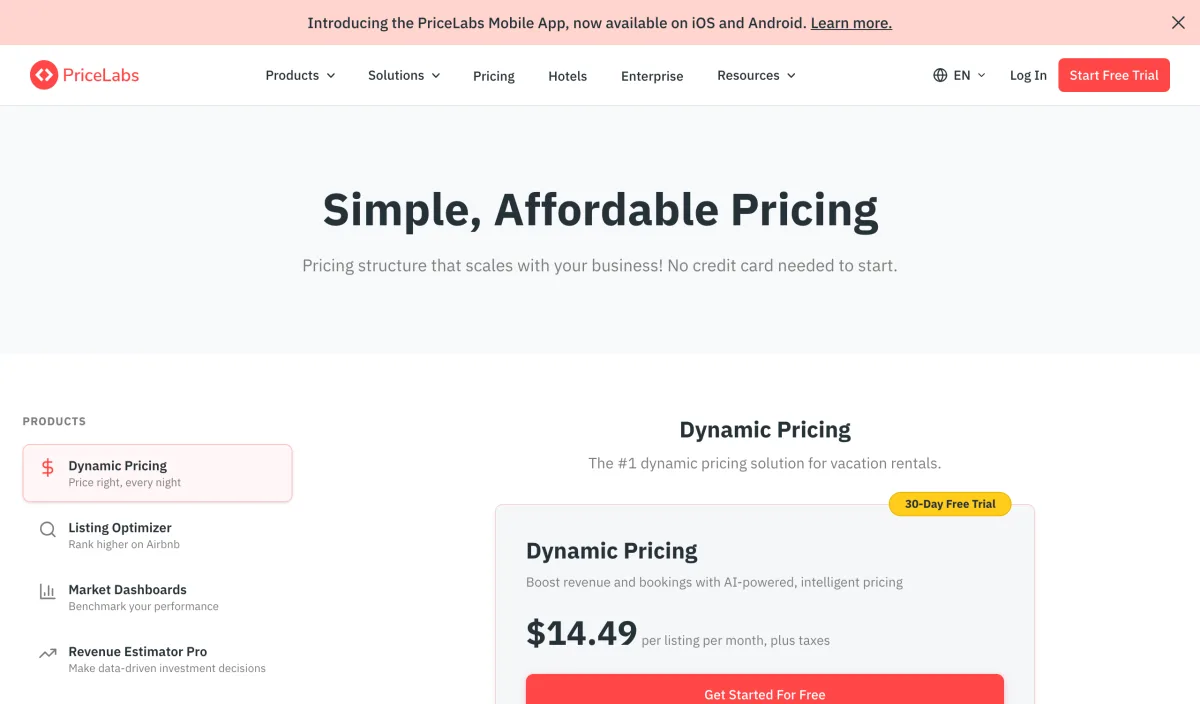
Best for: operators who want the most configurable engine and the largest body of documentation, community answers and PMS integrations behind it.
Start with the number on the page, because it will mislead you. The headline reads $14.49 per listing per month. That is not the price of one listing. It is the blended per-listing rate the calculator produces at its default position of ten listings. Move the slider and the real sliding scale appears:
- 1 listing: $19.99/month
- 2 listings: about $17.49 each, $34.98 total
- 3 listings: about $16.66 each, $49.97 total
- 10 listings: $14.49 each, $144.90 total
- 100 listings: $7.74 each, $774.00 total
Those figures come off the live calculator. PriceLabs’ own pricing FAQ gives the same standard rate: $19.99 per listing per month across the US, UK, Canada, Europe, Australia, New Zealand and Israel, $9.99 for much of the rest of the world, 47.50 BRL in Brazil, discounted on a sliding scale from the second listing onward. There is a 1 percent of booking revenue plan for anyone who prefers that shape, a 30-day free trial with no card, and two add-ons at $1 per listing per month each: extra daily syncs, and API access.
What you get for it is genuinely the deepest customisation layer in the category. Thirty-plus customisations, base-price and minimum-stay recommendations, far-out and last-minute pricing controls, portfolio analytics with ten templates, direct Airbnb, Vrbo and Booking.com integrations plus 150-plus PMS connections, and unlimited multi-user access.
The interesting development is Listing Optimizer, now a separate product on the same pricing page at a headline $10.19 per listing per month, again quoted at the ten-listing default. It grades your photos, title, description and amenities, scores your cover image against the property, compares you to local competitors, flags weak listings dragging a portfolio down, and shows a 12-week ranking trend.
I want to be precise about what that is and is not, because it touches a lever I have publicly scored as out of reach for software. Listing Optimizer is a content grader. It reads what is publicly visible about your listing and tells you what looks weak against comparable listings. It is not a funnel diagnostic. It cannot tell you that your first-page impressions are high while click-through is weak, because impressions and click-through live inside your Airbnb performance data and not inside any pricing tool. Those are different problems with different fixes.
It is also a real narrowing of the gap, and pretending otherwise would be dishonest. Beyond shipped a comparable product called Listing Lens. The whole tool category is walking toward the listing itself. If that continues, the seven-lever rubric will need rewriting, and I will rewrite it when it does.
- Pros: deepest rule set; widest integration list; free 30-day trial; the largest install base means the most documentation and the most people who have solved your problem already.
- Cons: the headline price is a portfolio blend rather than a single-listing price; the depth is only an advantage if you use it; it still executes a strategy rather than setting one.
Wheelhouse: Better Comp-Set Control, Same Two Levers

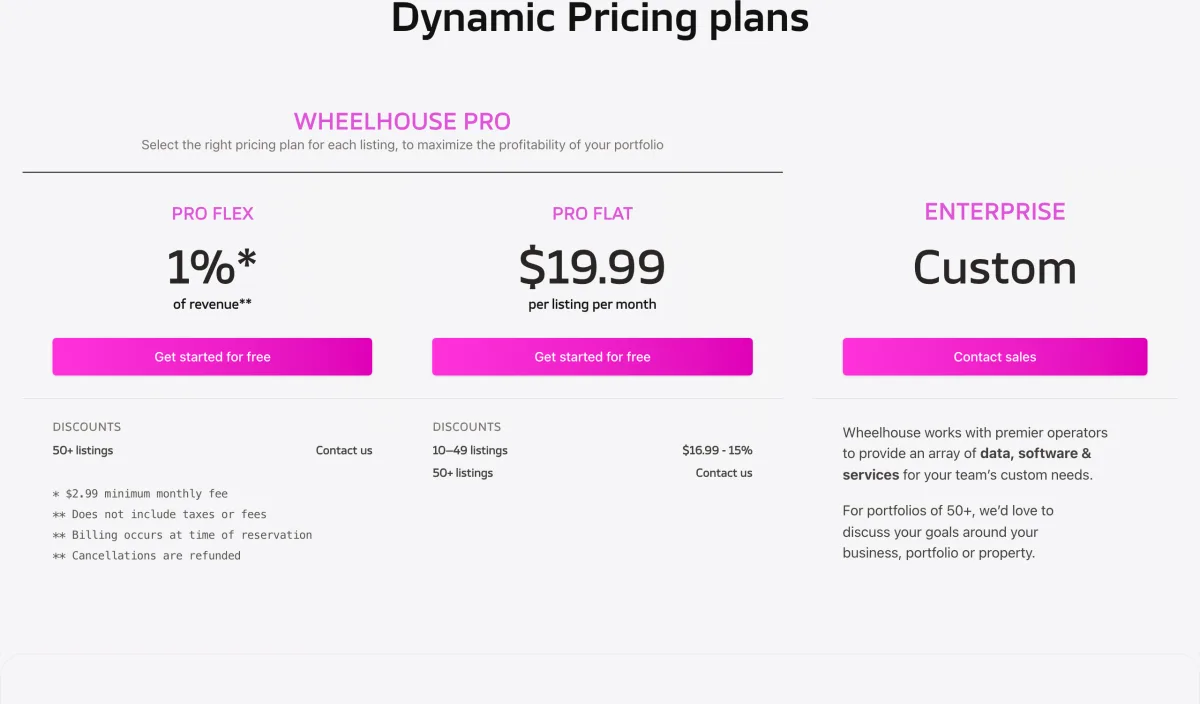
Best for: operators who want to build their comp sets by hand, or who want different listings in one portfolio on different billing models.
Wheelhouse publishes its pricing cleanly, and it is easy to get wrong anyway. Pro Flat is $19.99 per listing per month at any portfolio size. The discount is 15 percent, to $16.99, between 10 and 49 listings, and 50-plus is quoted by sales. Our own vendor list described $19.99 as a 10-to-49 tier price dropping to $16.99 at 50-plus, which is not what the page says. We corrected it the same morning we captured the screenshot above, and if you are reading a comparison that still says the flat plan starts at ten listings, check its capture date.
Pro Flex is 1 percent of revenue, with a $2.99 monthly minimum, billed at time of reservation and refunded when a booking cancels. The refund-on-cancellation detail is small and genuinely good, because it means a cancelled peak booking does not leave you paying a fee on revenue you never collected.
The reason to choose Wheelhouse is Dynamic Sets, at $12.99 per set per month. It gives you Wheelhouse Navigator, a mapping interface with 18 filter categories covering amenities, operators, occupancy and even cleaning fees, and lets you save comp sets that then drive your pricing.
This is the closest any tool in the category gets to lever one. It is not the same thing as knowing which listings Airbnb itself treats as your comps, which the platform will show you free inside your own calendar and which no third-party tool can see. But if your auto-built comp set is wrong, and in our experience auto-built sets need manual override roughly half the time, Wheelhouse hands you the better instrument for fixing it. I have written the full method for that in how to build a comp set that holds up.
The second reason is portfolio shape. Pro Flex and Pro Flat are selected per listing, so a mixed portfolio can put its high-revenue properties on flat and its marginal ones on percentage. Neither PriceLabs nor Beyond offers that: PriceLabs’ percentage plan is switched at the account level through support, and Beyond prices every listing as a percentage by default.
- Pros: best comp-set building interface in the category; per-listing choice between flat and percentage; cancellations refunded on the percentage plan; clean published pricing.
- Cons: no managed option at all; Dynamic Sets is a real extra cost, not a feature; the same judgment gap every engine has.

“Revenue management isn’t just pricing. Pricing is only one part of revenue management.”
Federico Zimerman
AirDNA Adapt: A Strategy Menu Built on Market Data

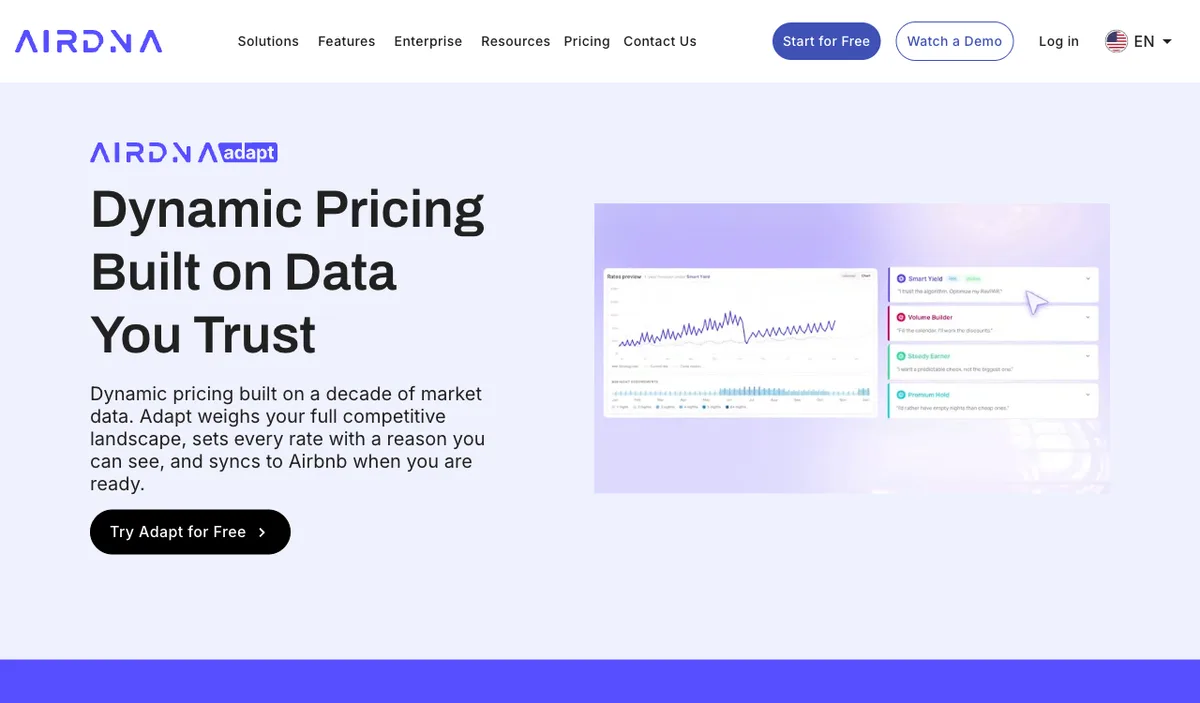
Best for: hosts who already trust AirDNA’s market data and would rather pick one named strategy than build a rule set.
AirDNA spent more than a decade as the market-data platform operators use for comps and acquisition research. Skift reported on September 1, 2026 that it was entering revenue management with Adapt, a dynamic pricing tool that had been in beta for nearly three months on up to 14,000 listings. According to AirDNA’s pricing page, Adapt costs $20 per listing per month with a 30-day free trial, which puts it level with PriceLabs and Wheelhouse on a single listing.
The design choice is the part worth understanding. Adapt prices around four named strategies. Smart Yield balances price and occupancy at the market rate. Premium Hold keeps rates above market with no last-minute discounts. Volume Builder fills the calendar first, with deep discounts stepped in near the date. Steady Earner anchors below market for predictable revenue from early bookings.
Per AirDNA’s integrations page, it connects directly to Airbnb or through Hostaway, Guesty and Uplisting, and publishes nightly rates and minimum stays every day. Its comps come from Airbnb, Vrbo and Booking.com data that AirDNA de-duplicates so one listing does not count twice, and every rate shows the reasoning behind it. You can connect a listing and preview the rates before anything syncs.
AirDNA also sized the opportunity. Its estimate, reported by Skift, is that only 15% of hosts worldwide and 31% in the U.S. use dynamic pricing at all. That is who Adapt is built for: hosts who have never run an engine.
Here’s the thing. Four strategies is a friendlier front door than thirty-plus customisations, and for a host who never opened their PriceLabs settings, that may be the whole improvement. Choosing between Premium Hold and Volume Builder is still a decision about your market and your property’s stage, and the engine executes whichever one you pick. Nothing on the product pages says when to switch strategies as the season turns. That is the same judgment gap every engine has, presented as a menu.
- Pros: built on AirDNA’s own cross-platform market data; four named strategies in place of dozens of settings; every rate shows its reasoning; free to connect and preview before you sync.
- Cons: new as a pricing product, with roughly three months of beta behind it; AirDNA’s integrations page lists four connections so far, while Skift’s launch report names six; choosing and changing the strategy stays your call, along with the other five judgment levers.
Head to Head, on the Things That Actually Differ
Two engines, one price
Where PriceLabs and Wheelhouse genuinely diverge
Everything both products do identically has been left out. What remains is the whole of the decision, verified on both pricing pages on 2026-08-24.
PriceLabs
Depth, adoption and a second product aimed at the listing itself.
Wheelhouse
Comp-set control and per-listing choice of billing model.
You could flip a coin between those two columns and be fine, and AirDNA Adapt at $20 joins the same coin toss. The decision that changes your revenue by four figures is the next one.
The Reframe: Tool, or Tool Plus a Strategist
None of these tools, AirDNA Adapt included, is the competitor to a done-for-you service. A managed service does not replace PriceLabs. It runs inside it.
RevFactor works through co-host access, which means the engine you already pay for stays where it is and a specialist decides what to tell it. The real competitor to a done-for-you service is a tool with nobody reading it, and that is not a small category. Federico put it plainly when he launched the business:
“My goal is to make sure that the fee you pay for revenue management services, which is a flat fee, is going to pay itself. Number one, by not having to worry about revenue management, which a lot of people just don’t even want to open PriceLabs because it’s challenging and scary or stressful. And number two, by capturing the revenue you’d otherwise leave on the table.”
The actual comparison
engine · operator · compounding
The question is not which pricing tool. It is whether anyone is reading the one you have.
01
The engine
what $19.99 buys.
daily repricing. seasonal and demand adjustments. gap-night rules. minimum-stay automation. far-out and last-minute controls.
execution, at machine speed.
02
The operator
what the engine cannot decide.
which comp set is true. what the funnel is telling you. what the minimum-stay rule should say this season. how to sequence a launch. which fee model to run.
judgment, weekly.
03
The compounding
why cadence beats sophistication.
small regular corrections against pacing. peak weekends watched in the final ten days. rules revisited when the market moves, not once at setup.
the lever most owners lose.
Update cadence is the lever that decides this, and it is the one people are least honest with themselves about. Every other problem on the list is solvable by someone who shows up regularly. A better dashboard does not create that habit.
What Each Option Actually Costs, Side by Side
Take one property doing $70,000 a year in bookings. Every figure verified on the vendor’s own live pricing page, PriceLabs and Wheelhouse on August 24, 2026 and AirDNA Adapt on September 14, 2026.
One property · $70,000 in annual bookings
Annual cost of each option
Flat plans are effectively identical across the three tools. The percentage plans are where the shape of the bill changes, and the managed service is a different order of magnitude.
So the managed service costs roughly six times the most expensive tool plan and about eighteen times the cheapest. The question that follows is arithmetic rather than opinion: does delegating the five judgment levers produce more than about $4,000 of extra revenue on that property?
On our own published case studies the range ran from +$5,538 to +$47,459 of on-the-books summer revenue against the same point the prior year. So the answer is defensible. It is not automatic, and any vendor telling you it is automatic is selling.
The line item nobody puts in the table
There is a cost on the tool side that no vendor page shows, and it is yours. Running a pricing engine properly is not a setup task. It is a weekly pass: read pacing, check the comp set, adjust the minimum stay for the season, look at the peak weekends still open inside ten days.
Call that an hour a week and you have spent 52 hours a year. Put your own number on an hour of your time and add it to the $240. I am not going to invent a figure for you, because your number is not my number, and a comparison that assigns you an hourly rate to make its own product look better is not a comparison. But the honest version of the cost table has that row in it, and neither vendor’s pricing page does.

“I don’t want to see a full calendar at $50 a night. I want to see money in my client’s pocket.”
– Federico Zimerman
Where Each Option Leaks Revenue
Every option on this page has a failure mode. Here they are, including ours.
The honest column
How each option loses you money
A comparison that only lists strengths is a brochure. These are the specific ways each choice goes wrong, and the conditions that make it likely.
1
PriceLabs
Depth you never configure
Thirty-plus customisations are an advantage only if someone opens them. Set up in month one and left alone, the deepest engine in the category performs like the shallowest one.
2
Wheelhouse
Sets built once, never refreshed
A hand-built comp set is better than an auto-built one for about a quarter. New entrants, tier shifts and exits make it stale. Paying $12.99 a month for a set from last spring is worse than free.
3
Done-for-you
$4,350 on a property that was fine
One clean listing in a market you know, converting well, reviewed weekly by you, is the case where a managed fee is straightforward waste. We will tell you that on the call.
4
Every engine
The five levers that are not settings
Funnel diagnosis, launch sequencing, seasonal minimum-stay strategy, fee model, and knowing when to break your own gap-night rule. No engine decides these at any price, and a menu of four AirDNA Adapt strategies does not change that.
When a $20 Tool Is the Right Answer
Plainly: most of the time, for most single-property owners.
A dynamic pricing subscription is the correct purchase when three things are true together. You run one or two properties in a market you already understand. Your listing already converts, meaning photos and reviews are not the constraint. And you will genuinely log in weekly and review what the engine did.
If all three hold, buy PriceLabs, Wheelhouse or AirDNA Adapt, spend the $240, and do not spend the $4,350. The engine will reprice your calendar faster and more consistently than you will, and for a clean listing in a familiar market that is most of the available value.
Two more cases where the tool is right and the service is not. A property in its first weeks where you are still learning the market yourself, because paying someone to be uncertain alongside you is expensive. And a low-ADR property where the arithmetic simply cannot work: on a listing doing $18,000 a year, a $4,350 fee is 24 percent of gross, and no lever moves enough to justify that.
The case for the service is narrower and more specific. It is a property where a single decision is worth four figures, or a portfolio where the same decision repeats. Federico’s Michigan example is the shape of it: a lake house in a market where every comparable listing ran a seven-night summer minimum, moved to three nights because the seven-night convention was survivorship bias rather than strategy. Being the only three-night option let the property charge more, and the summer came in about $20,000 higher. That decision is not a setting in any tool. It is someone looking at what the market filtered out.
Where the numbers come from
2026-08-24
Date the PriceLabs and Wheelhouse prices were captured from each vendor’s own live page
Competitor pricing is quoted, not estimated.
PriceLabs and Wheelhouse both publish their numbers, so both are quoted directly from hello.pricelabs.co/pricing and usewheelhouse.com/pricing, with the capture date on each screenshot. Beyond, quoted once above for context, publishes Growth at 1% and Pro at 1.25% of bookings with no flat option, and sells dedicated revenue managers separately as Guidance. AirDNA Adapt’s $20 per listing and its four strategies are quoted from airdna.co/pricing and airdna.co/adapt-pricing-strategies on 2026-09-14, with launch details from Skift’s September 1, 2026 report. Most of the managed category publishes nothing at all, which is worth noticing.
RevFactor figures are first-party: a flat $350/month per property for one to five properties, $150 one-time onboarding, $50/month per child listing, across a managed book of 198 listings in 67 markets and 24 U.S. states running +24% RevPAR against comp set. Case-study revenue is measured on-the-books against the same date the prior year.
How to Decide This Week
Three steps, in order, and none of them require a sales call.
Start the free trials. PriceLabs gives you 30 days with no card. Wheelhouse lets you start free. AirDNA Adapt has a 30-day trial and lets you preview its rates on your listing before anything syncs. All three engines are configurable in an afternoon on a real calendar, and an afternoon of your own data beats any comparison table, this one included.
Then ask the honest question about cadence. Not whether you intend to review your calendar weekly. Whether you have, for the last three months. That answer, more than any feature, decides whether you are buying an engine or an operator.
Then price the gap. If your property does $70,000 and the difference between the two paths is about $4,100 a year, the threshold is a 6 percent revenue improvement. If it does $30,000, the threshold is 14 percent and the tool is probably right. Run your own number before anyone runs it for you.
If the answer comes out software, the full vendor field is ranked here, software tier included and scored on the same rubric. If it comes out service, the when-to-hire guide runs the ROI arithmetic and makes the case for waiting where waiting is right. If you already run PriceLabs and want to know what a strategist adds on top of it rather than instead of it, that case is laid out on RevFactor and PriceLabs together. The method behind how we work is in the RevFactor method, and the measure that should judge any of it is in ADR versus RevPAR.
One last thing about the two tools, because it is the part people get wrong. They are not the expensive option and the cheap option. They are the same option twice, at the same price, and the money is not in choosing between them. It is in whether anyone opens the thing you bought. Every night that passes unsold is worth nothing the next morning. A dashboard nobody reads does not change that arithmetic.
Already running PriceLabs or Wheelhouse?
We will look at what your engine has been doing, where the comp set is wrong and which levers are sitting untouched, and tell you plainly whether you need us or just a weekly habit.
Frequently Asked Questions
Is PriceLabs or Wheelhouse better?
How much does PriceLabs cost per month in 2026?
How much does Wheelhouse cost per month in 2026?
What is Wheelhouse Dynamic Sets and is it worth $12.99 a month?
Can I use PriceLabs and a revenue manager at the same time?
What does a done-for-you Airbnb revenue management service cost compared to PriceLabs?
Does PriceLabs fix your Airbnb listing?
Is Wheelhouse's 1 percent plan cheaper than its flat plan?
Which is better for a single Airbnb listing, PriceLabs or Wheelhouse?
Do PriceLabs or Wheelhouse set minimum stays for you?
Should I switch from PriceLabs to Wheelhouse?
How much does AirDNA Adapt cost compared to PriceLabs and Wheelhouse?
Is AirDNA Adapt a revenue management service or a pricing tool?
Do PriceLabs and Wheelhouse offer free trials?
federico zimerman
Federico Zimerman is the founder of RevFactor, a managed revenue management service for short-term rental hosts. He spent 10 years in airline revenue management at American Airlines before applying that yield-management playbook to vacation rentals. Those strategies run daily across 198 STR listings in 24 U.S. states and 67 markets through Blackbird Hospitality, with a documented +24% RevPAR lift vs. comp set.
He's been featured on No Vacancy with Natalie Palmer (Ep. 155), Life of Flow (Ep. 93), Crafted Stays, and STR Like The Best (Ep. 54), and posts daily on TikTok (@federicozimerman) and Instagram (@federico.zimerman).
Read more from the Journal.



Ready to optimize your revenue?
Let's talk about your properties.
Schedule a free 20-minute discovery call to see what expert revenue management could do for your STR portfolio.